
I had therapy today. It’s often hard.
Especially when I stick around while it’s happening.
I restarted a few weeks ago, after a 6 month break. Sessions 1 and 2 I don’t really remember. I think I cried a lot. Or got panicked and overwhelmed and checked out a lot. I don’t remember what we talked about. Mostly that everything’s hard at the moment, probably.
Therapy is a time when different parts come out a lot (therapist makes sure of that, I think), and so when I’m checking out a lot, and overall integration / teamwork is low, that means a lot of amnesia.
My therapist was away last week, and after our last session, a lot of feelings were showing up, and I didn’t know what to do with them. So we all went back to what we’d been doing for a lot of the last 6 months: split up. Do our own things. Think fast, try to outrun the dissonance.
That tends to lead to a lot of arguments inside. The part that self harms doesn’t want to know that the part that tries to look after our body disapproves. The part that makes elaborate plans on the whiteboard shows up every so often wanting to know why no-one’s following their plans – but no-one wants to have to explain themselves for taking care of their own corner of things, and not following a laundry list of shit they never agreed to.
With only one body, a common response to all of this is shutdown, freeze. Faced with feeling like anything I do only makes things worse, my body decides that lockdown is the only option. Limbs get paralysed, my back doesn’t know what my front’s doing and vice versa. Pain and paralysis are the norm.
—
Be here now
This last week, I’ve been trying to do what my therapist and I talked about (or at least, what the follow-up email said we talked about): Just a couple of times a day, 5 mins or so of listening to EMDR bilateral beats, be present in my surroundings and my body. Be here now.
This type of mindful embodiedness tends to inherently bring us closer into contact with one another. There’s a whole thing with parts of the mind and parts of the body being inherently linked that gets squiffy in structural dissociation (or is that linkage a feature of SD? IDK).
Either way, when we become more present, we come into contact inside – even if we’re not really talking or playing well together right now.
And that plays out in the body.
Sometimes there are convulsions. Sometimes wretching (on one side of my body only, like my left half is trying to throw up but my right hand side DGAF). Sometimes it’s just emotionally overwhelming in minutes.
But I’ve been doing it – we’ve been doing it. And just a little each day often kickstarts these processes that are kind of the opposite of dissociation.
So today in therapy, I was ‘here’ a lot more of the time. Right now, that’s the weird experience. Being here for it.
—
So what does DID therapy look like?
(when you can remember it)
DID therapy happens, in theory, in a 3-phase structure, over months, and often years:
1. Stabilization:
Working with trauma is hard, it’s important that you and your therapist are on the same page about ‘who’s here’, who’s likely to show up during EMDR (Eye Movement Desensitization & Reprocessing), as too many big surprise appearances during a fairly vulnerable time can be retraumatizing.
2. Trauma exploration, witnessing, & unburdening
Parts come forward and share their stories, what happened, what burdens they’ve been carrying, often for years (say, 30 or more in many cases…). The therapist shows curiosity and compassion about behaviours that may be baffling and cause a lot of internal strife for the person. The person starts to realise that their parts have been doing what they’ve been doing to keep them safe, and to come into a place of compassion for their parts and in turn, themselves.
EMDR is one way of really being with the pain of a part, without becoming overwhelmed, and reprocessing memories in ways that access the strengths of other parts that have been growing & learning in the present – reducing the sense of helplessness & self-blame that are such a big elements of the ‘stuckness’ of traumatic memories & re-experiencing.
3. Integration & system re-orientation.
In reality, ‘integration’ is a process that’s happening all the time (for everyone, not just people with DID). Incorporating memories, experiences, identity, etc, into an overall narrative and sense of a coherent self.
It’s just that, after trauma processing / reprocessing, there’s often a lot going on inside, system reorganisation that happens organically, and this phase is kind of a ‘helping hand’ at making sense of life now things feel different. Perhaps some parts no longer feel the need to do the jobs they used to (say, self-harm, running away from safe situations that felt dangerous, or pushing away people in your life who you now see as trying to be supportive, where emotional flashbacks previously meant that connection felt like being controlled, or like the setup for abandonment).
That’s great – but often it means that you’ll find yourself in a lot of new situations, unfamiliar territory, and with an overall shifting sense of identity. This phase tries to help you make sense of it all and learn new skills that previously you never learned, because dissociation just kept you away from situations that, for many people, have been a normal part of life this whole time.
If you’re interested in reading more, the International Society for the Study of Trauma & Dissociation guidelines on DID treatment1 are widely considered the ‘gold standard’ – and IMO they’re sensible, and sufficiently flexible to individual differences, to make a lot sense. You can check them out here.
—
It’s almost never a single, linear process. There’s a lot of moving through each phase & ‘levelling up’; which frequently puts you back in the need for stabilization before you move onto deeper wounds that were just too dissociated to even be aware of before. It’s sort of like a cycle, or more like an upward spiral. You feel like you’re back at square 1 a lot, but with a little reflection, you often find out that, “holy shit – I’ve come a long way since I last felt like I was here…”
In reality, there’s often a bit of all of these happening all of the time.
Today was one of those, “doing a bit of each” days.
—
Talking to my therapist was full of weird moments. I stopped to break down crying at one point – just totally broke down, fully present with my own deep well of sadness for the first time in ages… had to totally stop, close my eyes, just hold myself… but as soon as I was done it felt like the feelings, and he, were very far away. Oh well. On we go.
I had to stop at another point due to intense confusion while trying to remember bits of the last week. I described it as being like, “multiple realities colliding”. Like my brain and my body had totally different memories of the last 7 days. When parts start talking inside again, often there’s a bit of reconciliation that needs to happen. Integration isn’t just being aware the others are there, it’s sharing memories and starting to work as a team again.
Apparently we have to go really slowly.
I hate going slowly.
—
In every colour, a part of her
To give you a bit of an idea of how we talk about parts, and the ways in which metaphors and resonant media can help explain inner experiences:
Many parts are, at times, non-verbal, and the idea of, “talking inside” is often metaphorical. So art is often a really good way of helping them communicate when words aren’t available.
We talked about art I’d drawn recently, that I sent him pre-session. Particularly about a piece I’d drawn referencing the video game Clair Obscur: Expedition 33. To my surprise, I was able to tell him exactly what I’d drawn and why – to talk about grief, death, and the inner spark of fight & hope certain parts have been showing in the face of a bleak reality I feel like *I* have given up on.
I’ve included it below – if you’ve played the game, you might be able to figure out what’s going on. If not, it should be too obscure (*wink*) to be a spoiler at this point.
—

—
I talked about the soundtrack, particular Une Vie a t’Aimer and how lines like ‘pleurer en couleur‘ (crying in colour), ‘en chaque couleur un part de lui‘ (in every colour, a part of him) and Victor Borba’s wailing get me in a really visceral way.
I talked about how the game has a lot of themes about grief & hiding from it in imagined worlds, loosing sight of what you & those around you need to go on with ‘real life’. How at times the story touched nerves I have about suicide being a choice that would end the lives of all of us, not just the one making that choice.
Let’s just say the story has so many themes that connected with me in deeply personal ways.
It was a good way of getting into being able to talk about us again.
See, DID tends to involve a rich and intense inner world. That’s definitely true for me. It’s something that, in recent years, let me be an (I’m told) incredible Dungeon Master in D&D. It’s something that helped me survive as a small and often lonely kid (despite having family & friends around me a lot of the time). A lot of My Core Shit is around something called, “childhood emotional neglect”, and often my inner world is the only place I feel safe, well… feeling. I often choose to be there rather than the ‘real world’ in a heartbeat.
My parts sort of live together both in this inner world, & the ‘real world’ (because they are me & I am them). They hold a lot of my different feelings (and, relatedly, needs), separate from one another. ‘Compartmentalised’. When we journal, whiteboard, or make art to talk to each other (something we have to do when we’re struggling to communicate inside), we often write/draw in different colours.
For example:
Ellie is pink; she’s pretty down to earth, social, fun, just wants to get on with having a normal teenage life; friends, get weird with boys (and girls), chill silliness, dancing – playful.
Chance is royal blue – calm, collected, thoughtful, compassionate; a grown-up psychologist with a lot of time for everyone else’s needs. He handles a lot of work type stuff, and connecting with other people in our life when they’re hurting.
Jesse is red, and recognises anger in ways I struggle with – uses it go, “Hey, something’s not right here – time to stand up for myself”. He’s often kinda juvenile, sarcastic, he’s a dick sometimes, a lot of fun when he’s not mad, and I love him to bits (aww shucks! – J) We’ve had the most fallings out by far. But I’ve come to appreciate everything he’s done for me all the more every time.
Alyx, purple, holds a lot of fear & flight. They’re sensitive but so, so thoughtful & caring. They’re also probably the shiest of us.
Harley, light green a lot of joy & wonder, going towards. Playful, loves comfort, warm blankies & snuggles. Plushies are friends. Also calls the bear on our shower curtain, “pervert bear” & has conversations with them while we pee. IDK – they’re not wrong, you’d know what they mean if you saw the curtain.
Aeryn, forest green, soulful connection with each other inside, the peace of being in a quiet woodland – just being.
Phoenix, blazing orange, pride and presence – being seen.
I could go on.
My parts aren’t feelings, they just have those they tend towards. When people say DID is like having ‘other people inside’, they’re not kidding – everyone inside is different, and they’re all rad. My therapist and I sometimes reflect together on the perhaps slightly weird situation where, rather than wanting to ‘get rid’ of my parts, as some people with DID struggle with; I think mine are rad and that “I” suck. Yeah – shit’s complicated, yo xD (Mark S rules, Mark Scout drools, etc – Severance reference).
In the session we went round, I gave updates on how a few of us had been feeling, what had been going on for us. Sessions like this (when I’m present) tend to take the form of me talking on behalf of each of us, rather than, “switching” between parts & their first person perspectives constantly.* When I’m not there… well, I don’t remember much, if any of it, I just know switching/shifting a lot tends to bring on a lot of headaches & sleepiness after. It’s all good – it takes a lot of trust for us to be together with another person, and sometimes you need those parts-y sessions, being held one by one, to get back here.
So yeah, we’re getting the band back together. Integration. Communication. Teamwork. Family.
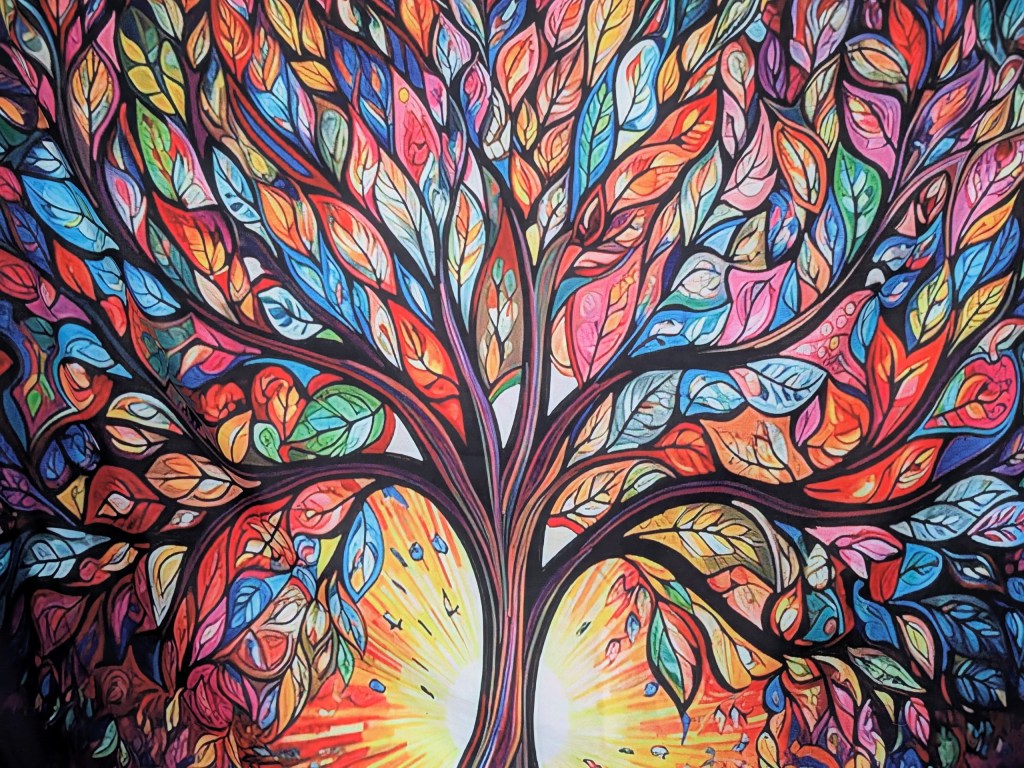
The header image for this site is a wallhanging that’s brought me back to myself, and been the background for us finding one another again so many times these last couple of years. When we’re working together, and feelings can co-exist, and shift naturally – it feels like the entire world goes from monochrome to glorious technicolour.
—
—
In every colour, a part of her.
Work in progress.
Take care of yourselves, kiddos.
Riley & fam ❤
1 International Society For The Study of Trauma & Dissociation. Guidelines for Treating Dissociative Identity Disorder in Adults, Third Revision. Journal of Trauma & Dissociation. 2011 Feb 28;12(2):115–87.
* It’s like in the game The Alters, when Jan is telling command via video link how his cloned alters are doing alone together in a space base… it reminds me of strongly of these kinds of therapy session xD
—-
 Three Kids in a Trench Coat
Leave a comment