
—

—
Severance is an amazing TV show.
It’s also a great portrayal of certain aspects of dissociation, particularly Dissociative Identity Disorder (DID). The word, “dissociation” means “severance; division; disunion.” (from the latin dissociare – to sever or divide).
Dan Erikson, the show’s creator, has said the idea came from back when he worked a crappy job he didn’t enjoy, and spent his days wishing he could dissociate the day away – get in at 9am, and suddenly next thing you know, it’s 5pm and you’re leaving. Apparently, closely followed by, “That’s a scary thought – wishing to have less precious time on this earth.”
Severance is a show that takes that idea, and asks, “Well, if you’re not in the body right now… then who is?”…
… and then runs with it – spectacularly.
—


—
I was hooked on this show right from episode 1, after a friend recommended it to me as, “Heeey – so this show isn’t about DID per se… but you might find it interesting…”
Boy was he right.
So read on, if you’ve seen the show, and “real life severance” sounds interesting to you…
Obviously major spoilers ahead, up to and including the Season 2 finale.
What is Severance? A quick innie/outie refresher
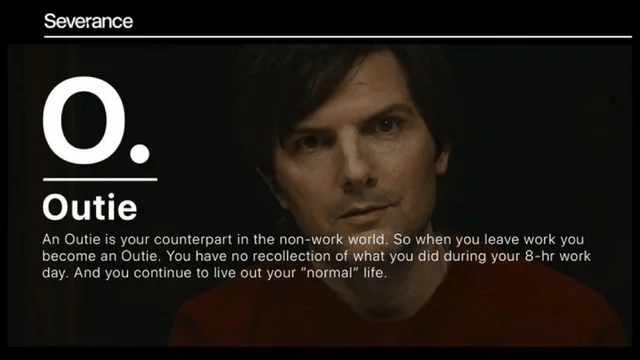
In Severance, “severed employees” have an ‘innie’ who goes to work, and an ‘outie’ who lives their life outside of work. It’s a process an unsevered person can choose to undertake – a small sci-fi chip implanted in the brain, that “spatially dictates” their memories.
In essence, the person making that decision remains the “outie”, and the ‘innie’ is created from the moment they wake up on the conference table on the Severed Floor of Lumon (if this turned out to be a nod to Fraser’s Dissociative Table Technique, that wouldn’t surprise me xD).
Outside of their job at Lumon, severed employees continue to have access to all their memories – except those created while on the Severed Floor. In the show’s term, these are the times their, “outie” is awake. Out in the world, it’s all the outie’s domain in terms of memory, identity, personality, driving the body.
—
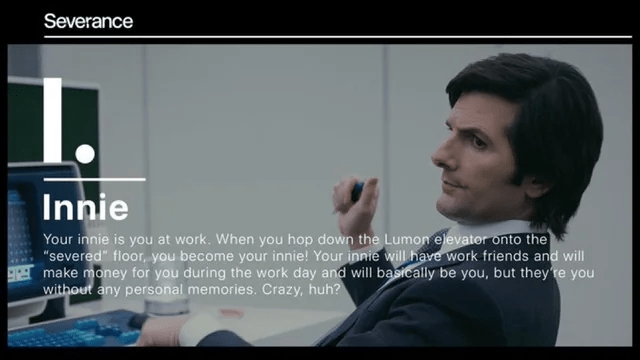
In contrast, upon successful severance, innies start their life largely limited to general knowledge, such as naming an American state, knowing that rain is water that comes from clouds in the sky, and the fact that there is a thing called, ‘the sky’ and it looks blue.
However, the intention seems to be that innies should not be able to access autobiographical or first person sensory memories, such as where they were born, what their mother looked like, how it feels to stand in the rain, or how that rain smells when it lightly kisses the grass in spring…
That’s how Helly R’s life as an innie starts in S1E1 – waking up on a conference table, understandably confused and being quizzed by Mark S over the intercom, accidentally kicking off…
“Who are you?”
That’s a big question for anyone, let alone someone who’s just been chipped & dipped… onto the office conference table, unconscious. Only to be roused by the world’s most nervous pub quiz announcer.
She doesn’t even know about The Ball Game yet.
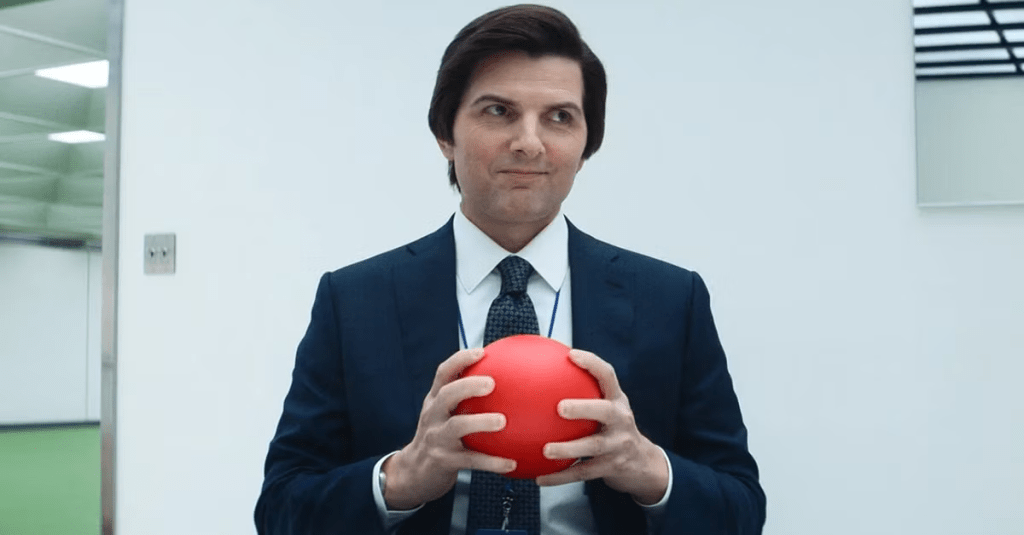
Poor Helly R – no wonder she gives everyone hell.
—
This results in two different ‘selves’ (in DID, often called ‘parts’ or ‘alters’). For example, the main character Mark, is Mark Scout outside of work, but while he’s at his job at Lumon, he is Mark S – and they alternate, laying down new memories that only they as an individual can access, and their other self cannot.
This is, in essence, a lot like what having parts or alters in DID can be like. Parts can often remember things that they were present for at the time, while being unable to recall times when they weren’t around – which can look like amnesia for important life events long past, or suddenly being surprised by where they are or what they’re wearing, unable to retrace their own steps mentally.
Real world innies & outies – dissociative parts in a nutshell
Broadly, dissociation can refer to many things – but in the Diagnostic and Statistical Manual for Mental Disorders 5, Text Revision (DSM V to her friends) there’s a section on different, “dissociative disorders” – including:
- Depersonalisation (not feeling real, feeling like your body doesn’t belong to you…)
- Derealization (feeling like the world around you isn’t real, or like it’s very far away, foggy, or ‘wrong’)
- Dissociative Amnesia (not being able to remember everyday stuff and/or big important details about yourself or your past)
- Dissociative Identity Disorder
That last one involves having two or more parts of your identity, that take the driver’s seat, and when they switch, the person can, ‘lose time’, and forget what happened.
Here’s the relevant DSM criteria, if you’re interested:
DSM V-TR criteria for DID
A. Disruption of identity characterized by two or more distinct personality states[…]. The disruption in identity involves marked discontinuity in sense of self and sense of agency, accompanied by related alterations in affect, behavior, consciousness, memory, perception, cognition, and/or sensory-motor functioning.
B. Recurrent gaps in the recall of everyday events, important personal information, and/or traumatic events that are inconsistent with ordinary forgetting.
There are three more, but C. is about whether A. and B. are distressing to the person, and D. and E. are basically about differential diagnosis (“not better explained by…”)
—-
Switching in real life
There’s a turn of phrase, and variations of it, that gets used a lot in DID, the idea of, “the front”. When a part / alter is, “out front” / “up front” / “at the front”, it refers to part that is currently, “driving” the body and making decisions. This does not necessarily have anything to do with masking or pretending in a, “bullshit – you frontin’!” kind of way.
It’s simply the part of the person that is currently in executive control.
When a part is not, “at the front”, we often will say they, “go back inside”. Some front a lot, for a long time, sometimes they swap in and out pretty freely throughout the day. Some parts rarely, if ever, front, and are always, “inside”.
It’s often a bit more complicated than a straight up “either / or” situation. Parts can “influence” from inside, or can be co-conscious (co-con), and / or blendy – but sometimes it is like, “one part is out front” then there’s a “switch” (another common term), and a different part is out front (a new duck).
The person may or may not be aware during the switch – sometimes this is where the experience of, “losing time” and amnesia come from, but it’s also possible to be aware of the switch happening and feeling like a passenger during some of, or even the whole, process.
When parts are at the front, or close to it, their memories tend to be fairly easily accessible. When parts are “deeper inside”, their memories may not be accessible at all, unless they’ve chosen to share them. They can also be patchy, foggy, emotions without narrative, or narrative without emotion, like they happened to someone else… but yeah, they can also be straight up unavailable.
Some people with DID have an, “inner world” that includes a system for accessing the front. For us, we have, “The Treehouse” which is kind of a co-con space near the front, and the part(s) at the front go out onto the balcony or roof of The Treehouse (The Deck), where’s there’s a column of light leading to the body (but they can always easily check in with The Treehouse to chat / check-in, without going “all the way inside”, which can be a lot).
Think of it a little like the elevator to the Severed Floor…
♫ Switched from 9 til 5, what a way to make a livin’… ♫
DID starts in early life, to help that small child survive in the face of repeated overwhelming experiences (although parts can continue to emerge at any age). Severance is a sci-fi procedure that lets people do something similar – but starting much later in life. Being a system isn’t all bad, in fact it can be pretty cool – it’s the trauma that’s the bitch.
But why would someone choose this sci-fi version of DID as an adult?
Well, the outies in Severance have their various reasons for taking the job. For Mark – its about escaping the pain of the losing his wife.
As we learn, he tried to keep teaching and according to his sister Devon, it was, “a disaster”. Unable to cope with the grief, he started drinking heavily, and couldn’t hold down his old teaching job, too haunted by the memories of his wife and the overwhelming loss he felt.
Similarly, in DID, some parts/alters keep trauma away from other parts (often those most involved in going to work, staying housed and fed, hanging out with friends, etc), so that the person can get on with life without being overwhelmed.
And, in both cases – what can sometimes work well as an ingenious solution to unbearable suffering (Mark Scout, “It’s helping me”), can also lead to a lot of… unconventional experiences in day to day life. Not to mention it’s really hard to explain at dinner parties… if you could even remember… (“I’m just not grasping the visceral element of it…“)
So what is the “visceral element” of dissociation like?
“WTF were you doing with the body while I was inside?!”
Ahem. That’s totally not something one of us said today. No siree.
Early in season 1, most of the severed employees we meet have this chip-induced compartmentalisation, and these ‘amnestic barriers’ (‘time loss’ / blackouts / amnesia when ‘the other one’ is up front), very much in tact.
This is, in one sense, similar to the experience of having DID before you knew about DID, parts, and quite possibly, before you were aware of even having trauma in the first place – amnesia covers many tracks – essentially: “I can’t remember what I can’t remember…”
Except – both innie and outie are pretty clear on the deal – so it’s more like knowing you dissociate, but making no attempt to get to know your parts better, and no attempt at integrating what has been severed.
The ‘dissociative structure of the identity / personality’ is still very much ‘in tact’, to use a clinical turn of phrase.
—-
I loved when Helly R first ‘goes home for the weekend’ Friday evening… only to enter the elevator, and ‘switch’, opening her eyes a moment later and seeing… the elevator, arriving back on the Severed Floor… at 9am on Monday.
Mark S explains to Helly R that, yeah – they don’t experience going home, weekend time off, or going to bed… but that she may notice the benefits of sleep and relaxation now – “you may feel rejuvenated or happy… less tense in the shoulders… spry…”
Lingering, subtle sensations and emotions that feel alien to the person experiencing them, and like they come out of nowhere, are sometimes called ’emotional echos’. Emotional echos are left by parts that have been present, after they switch away from the front. These can be confusing, but you can also learn to identify echos and the feelings that tend to be a signature of specific parts after they’ve been around.
The reverse of this can be true too – a switch can come with a sudden and all encompassing change in feelings.
—-
You see this flip-side for Mark sometimes in S1 in particular.
In the first episode he comes into the office after sitting in his car crying his eyes out, followed by a slow, hunched shuffle into the building… But after he goes down that elevator, there’s that “bing!” as he switches to Mark S… and his posture immediately changes. He strides unbothered through those white corridors, and finding a tear-stained tissue in his pocket, and looks at it with a moment of, “huh, what’s on this?”, shrugs, and tosses it into the bin without a care.
Dissociation and the body can get real problematic over longer periods of time – and it seems to have a lot to do with emotions. Dissociated parts holding big emotions, whose cries go unheard over and over, still play out in bodily sensations, just without the affective element that fuels emotional processing.
If this is happening all the time, the brain will just, “Disconnect this device” to stop the constant Windows connection sound distracting you constantly. Which results in patterns of feeling like parts of your body “aren’t there”, while others are in searing pain from compensating these AWOL parts.
So yeah, being able to make narrative sense of what’s happening with these otherwise seemingly random sensations is important – as Mark is doing in his explanation to Helly.

Tension & absence. Frantic & frozen.
And yes… yes it hurts.
—-
One last thing I’ll say; the scenes where Helly R / Helena Egan switch in the middle of something violent happening to them hit us real hard. The suicide attempt in the elevator in S1, when Helly R hangs herself, so that Helena Egan switches in as it’s happening… *shudders*
We’ve never tried, seriously, to commit suicide. But I have come back to awareness in the middle of self-harm, including being smothered & completely denied air for some time… and so… I know what it’s like to have a part trying to get your attention that way. It’s scary. But I know why they were doing it. I try not to ignore that shit, and find a common ground & go from there – unlike dear old Helena Egan.
—-
The compartmentalised systems of Lumon Industries
As a brief aside – it’s interesting that Lumon’s Severed Floor itself has real dissociative system vibes to it.
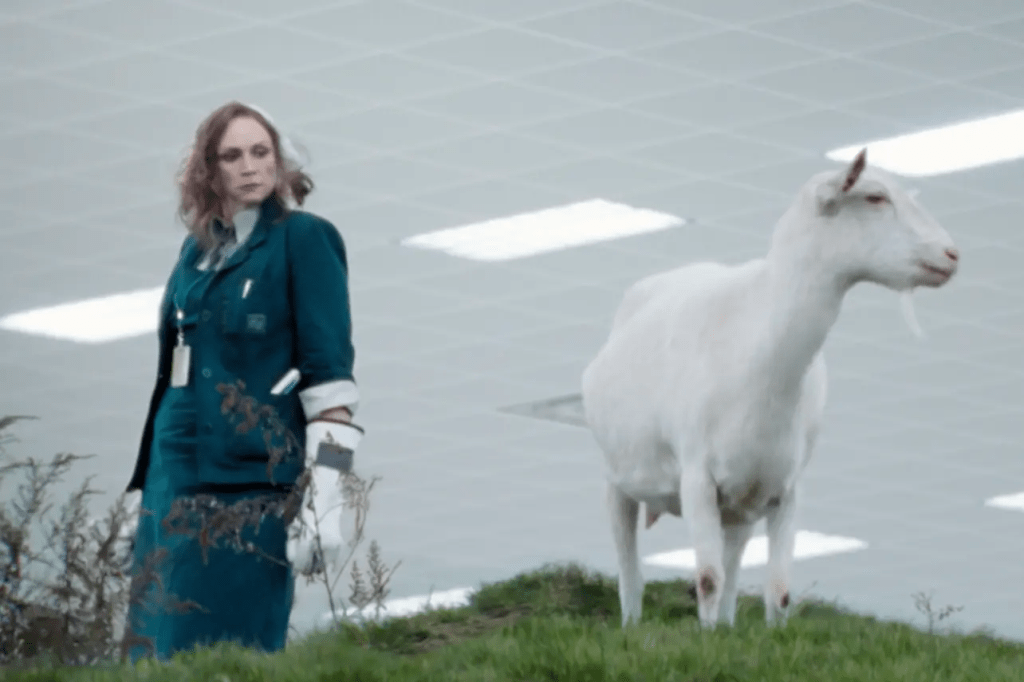
The “staggered starting and leaving times” (so “there’s less chance of us meeting each other on the outside”) that Mark explains to Helly alongside the sleep stuff is one of many examples of that familiar ‘dissociative compartmentalisation’ that comes up time and again in the first season. Another is the way all the departments are kept separate from one another, even on the Severed Floor itself – leading to such mysteries as, “what the fuck is with those goats?!“.

We stan Gwendolin Cristie, and her love for those delightful goats.
System Communication – the Season 2 finale
There’s one episode in particular in all of the show that spoke to me more than any other – the Season 2 finale.
The first 20 minutes or so of the episode focus on an ingenious solution to Mark Scout & Mark S’s inability to communicate (thanks to the Lumon “no unapproved messages in or out” policy). The birthing cabin that the senator’s wife uses to stay free of the experience and memories of childbirth – thanks to being severed, for that very reason…
Well, turns out, while inside, whatever activates the switch in Mark’s chip at Lumon does the same here.
In other words, while in the cabin, Mark is Mark S, and as soon as he steps outside, he’s Mark Scout again. Devon & Ms Cobel hand Mark the means to, after 2 seasons, have a conversation with one another – a handheld video camcorder.
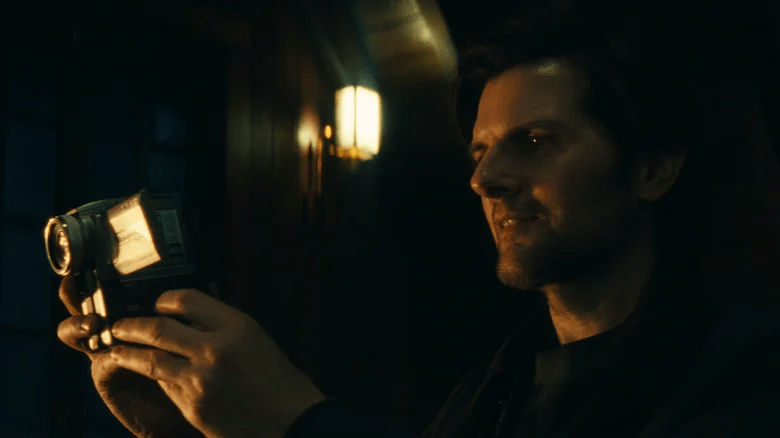
Mark S records a message inside the cabin, steps outside, *switch*, and Mark Scout is still holding the camcorder, records one right back, etc.
I love this scene. Not only is it a huge moment story-wise, but also; recording videos for one another between switches is one of the ways of communicating that we use. I tend to use it when I want to talk to a part that isn’t ‘here’ in co-consciousness right now (and doesn’t need to be). Or if I want to leave someone a reminder that I care about & appreciate them, they can watch if they find themselves out front without me.
In contrast; talking out loud to parts ‘live’ and au natural (i.e. “just talking to yourself”, perhaps in the mirror, for example) has a few limitations in our experience. Not least because it can get confusing as hell, talking and listening for internal reactions at the same time.
As for rapid switching to let dialogue for both parts play out, out loud… ooof. I don’t recommend it – the Default Mode Network, and therefore, the Inner Critic, tend to slip into these conversations really easily, characterised by wrote messages absorbed from childhood, (“Try harder”, “You always mess things up”, “Why can’t you just be normal?”)… and then everyone ends up having a bad day.
You can also quickly lose track of who’s talking and who’s listening, and more parts can become activated… just thinking about it is making me feel blendy.
So even if the parts you want to talk with are around, videos or voice recordings help slow things down & mean you can shift focus from who’s at the front right now, doing the talking, to the listening when another part is out front, and back again etc.
Asynchonous communication as with the Marks and the video camera, is a common technique for dissociative systems – one recommended in therapy by DID specialists the world over. Whiteboards, a journal for everyone to write in, post-it notes, voice messages, videos – anything that allows one part to leave a message while they’re around, for other parts to pick up later.
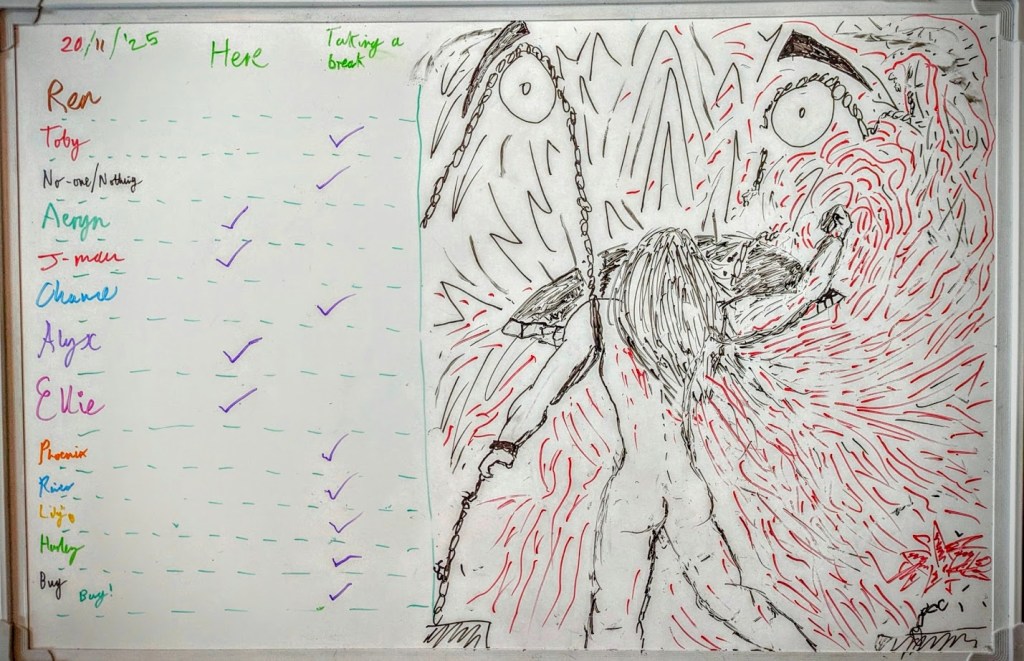
Now, these kinds of thing are built into our everyday life.
But go back 2 years, and the first time I did this, after realising that the me that went to work was, “So like a different person they don’t even seem to know I exist” – was in the form of writing.
That’s right – big, simple A4 signs in sharpie are how my ‘innie’ learned that my, ‘outie’ existed, is trans, and wanted to make some pretty significant life changes… a year before I even knew what DID was.
It took some time for a relationship to form and reach the point that our transition could move forward, that’s for sure – but when it did, it was a pretty huge moment in our life (turns out, not just because of the gender thing, when we realised there’s more than just 2 of us in here…)
Even when parts / alters do find ways to communicate, be they inside, or through various equivalents of answer phone messages – things don’t always go smoothly…
—
Can’t You… Just… Trust Me?
Of course, in the Severance Season 2 finale, things go anything but smoothly when the Marks talk to each other.
Mark Scout makes his request of Mark S – help me free my wife.
That’s it, that’s the whole thing. He hasn’t even thought about how the whole thing might sound to Mark S, or what his motivation to help might possibly be.
Well… Mark S immediately sees things from his own point of view, obviously – helping you with that would result in the shutdown of the Severed Floor – meaning I, and everyone I know & care about, would essentially never wake up again. So I’d “really be helping you out”… by dying for you. You’re asking us to die for you.
It doesn’t help Mark Scout can’t even remember the name of the most important person in the world to Mark S – who, correcting Scout’s “Heleny” flub, says:
“It’s Helly, actually… that’s the person I’m in love with… which you’d know if you’d ever taken interest in my life… before tonight when you needed something…“
Big. Oof.
Been there. Been there more than once, my dude.
When Mark Scout tries to mollify him with talk of reintegration, Mark S questions whether it’s even possible. Mark Scout starts to lose it and finally, frayed, exclaims, “We are in this together… can’t you just trust me?!”
The simple reply recording comes back swiftly.
“No.”
It’s not uncommon for parts that have been, “shut out” or “shut down” within a system to feel like this. They can feel unwanted or unappreciated. Often in DID, there are young parts, that may have wanted help for a long, long time – crying out with no reply.
Regardless of whether a child or adult part, they may not be open to requests from the host or other parts in the system until some level of familiarity & trust been established. The needs and wellbeing of that part have to be made a genuine priority in terms of actions, and taking notice when they’re in need – words are often not enough.
Parts also often worry that the person will try to “get rid of them” (as Mark S does) – often because, when first starting therapy, that’s what a lot of people with DID would really like to happen (as Mark Scout quite possibly does, who knows..)
In my system, by the first time I spoke to Jesse, I’d been scared of meeting “whoever or whatever was over there in the shadows” for years.
And when I tried to say hi for the first time, I got a pretty clear, “Fuck you & clear off“. In fact, the first time I tried, “going inside” at all since transition, to able to get any sense of other parts… well, I lost three days…
It takes time, commitment, patience, compassion… it’s a lot like, y’know… relationships with people. Because that’s exactly what they are.
Funny, that… Helena Egan, I’m looking at you (S1 video message to Helly R – “I am a person, and you are not…“).
—
Mark S ends up going through with the plan to rescue Gemma – but he himself doesn’t follow once she’s out the fire escape, choosing instead to keep hold of the front as long as possible.
Sure, Lumon’s severed floor is… somewhat in uproar, but he isn’t ready to give up his existence, his life, or Helly, and wants to keep fighting for them here, where he has agency.
This is a bit like what happens when parts needs are repeatedly ignored. Eventually, they can, “take the wheel”, and start driving the body without your awareness or permission.
This happens to us from time to time, and these, “non-negotiated switches” or periods of refusing to pass the driver’s seat back, after their planned time up front has passed, is a big part of where having a dissociative system can go from being just another way of being, to causing difficulties in every day adult life.
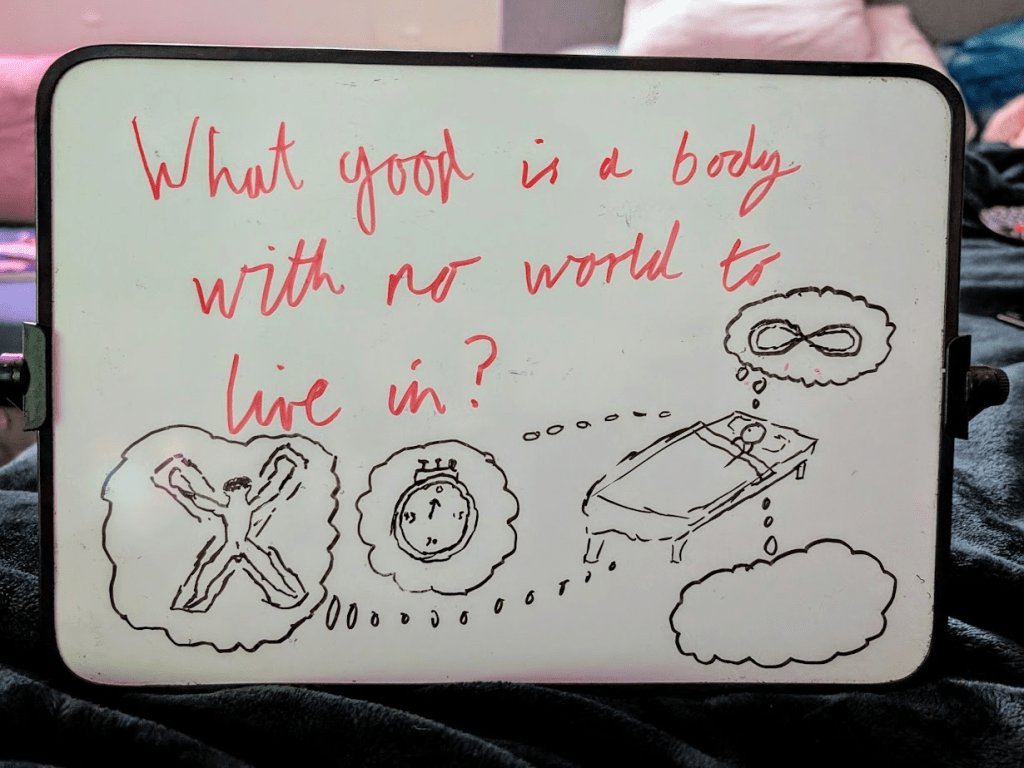
Mark S never even agreed to the plan.
He either just doesn’t trust that Mark Scout on the outside will keep his word to find a solution, to reintegrate – or he doesn’t want to become a mish-mash of the two of them at all… he knows himself, and he kinda likes who he is… and honestly, all he knows about Mark Scout is that he seems self-absorbed.
Well, and that he can put up a tent in under 3 minutes, I guess (thanks, Ms Casey – I enjoyed that fact equally).
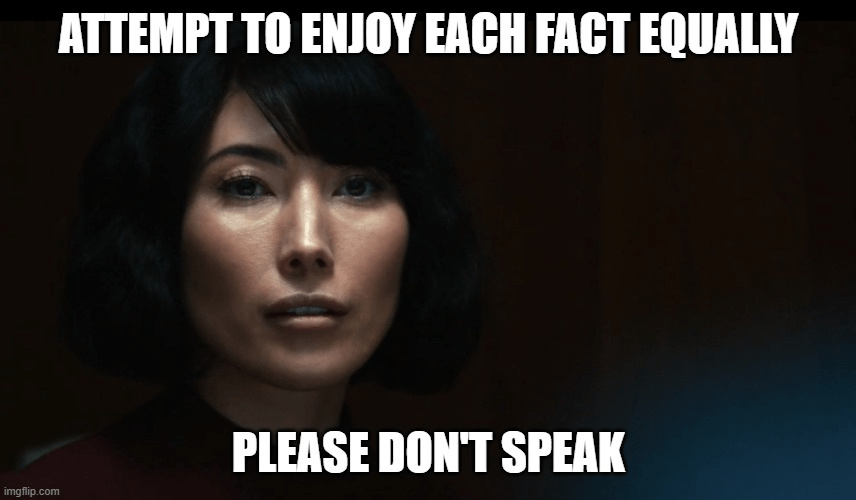
Honestly, I have parts that relate to Mark S.
After the video camera conversation, when Mark Scout yells: “He’s like a child! I even mentioned reintegration and he basically called the whole thing bullshit!“
Devon replies: “Well, I mean he’s not wrong, right?”
Because integration is a hot topic for us, as it is for many DID systems.
Final Fusion (Kier Mania Remix 2.0)
In therapy for DID, “integration” is usually one of the core goals. This doesn’t mean “getting rid of” parts. It means bringing them closer together – better able to communicate, share memories, be more co-ordinated about what we’re doing in life and in our day to day, and to be more co-ordinated in our body.
Severance’s portrayal of ‘reintegration’ so far indeed involves the walls between outie & innie memories breaking down. It hasn’t exactly worked out smoothly for Petey, or Mark Scout so far – so it’s hard to tell how the process is meant to go next (I’m assuming “Fall down dead in the snow looking for vending machine snacks” wasn’t one of Petey’s treatment goals).
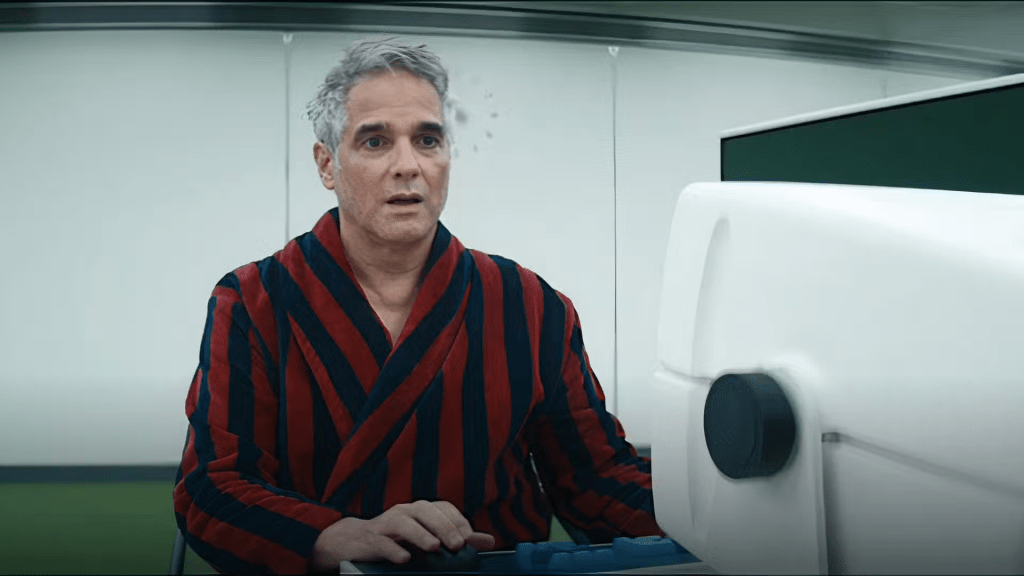
In particular, the question of how the person experiences the world now they’ve suddenly got access to the memories of two very distinct parts that, as Petey demonstrates, aren’t necessarily easy to integrate at the level of somatic experience (the body keeps the score…)
Also, do both those parts still experience themselves as separate “I”s? Can they each take control of the body & switch? Are innie & outie co-conscious with a new “host”?
Do they become one self, with no separate parts, no innie & outie? “Just me.”
In DID therapy, this last state is called ‘final fusion’ – the result of (often years) of integration through therapy & healing experiences as a system. As the ISSTD Guidelines on treating DID (the international gold standard), summarise:
“Integration is a broad, longitudinal process referring to all work on dissociated mental processes throughout treatment.
Fusion refers to a point in time when two or more alternate identities experience themselves as joining together with a complete loss of subjective separateness.
Final fusion refers to the point in time when the patient’s sense of self shifts from that of having multiple identities to that of being a unified self.”
‘Fusion’ is when two or more separate parts / alters / fragments ‘dissolve into’ one another. It can happen during integration by itself when unburdened parts find themselves becoming close to kindred parts. When all parts are combined, what’s left, in theory, is one person, one self – no parts’ memories, skills, or personality etc is ‘lost’ per se – they’re just all held within a single self.
It’s very common for systems to have strong opinions on whether or not final fusion is something they even want:
“A desirable treatment outcome is a workable form of integration or harmony among alternate identities […] Even after undergoing considerable treatment, a considerable number of DID patients will not be able to achieve final fusion and/or will not see fusion as desirable.”
Many, if not most systems, express a preference for “functional multiplicity” as a goal. That’s where we all have our own thing going on and we can form up – many voices, but capable of acting as Us, Together.
Like Voltron.
Or the Megazord.
God my system is full of nerds xD
(note to self & fam – pitch a parts-y video game and call it Final Fusion…)
I’ve done a whole lot of integration these last few years; experiences, parts, memories, feelings, that were either walled off or behind dense fog, coming closer together, more connected.
I’ve only experienced temporary fusions, though – including once or twice, after a period of intense activity inside, waking up to the sense of, “Wait, where’d everyone go? Is this re-traumatization?!” and after I’d explained what I was experiencing, my therapist saying, “That… sounds more like fusion…”.
“Ok, but… everyone?!”
I didn’t like it. And it didn’t last long. Apparently temporary fusions are not uncommon, kind of a, “trying it on for size” kind of thing – and there are all kinds of reasons it doesn’t stick.
—-
While not always quite so dramatic as Petey’s reintegration sickness (although, eehhhhhh…) – this is what DID can be like when your, “worlds collide”, when amnestic barriers start to lessen and parts start becoming more apparent to you.
Flashbacks can start to happen, or become more frequent, and this sense of overlapping identities, perceptions, conflicting sensations in body & narratives in mind… well, those can all start, or ramp up, too.
Starting therapy for complex trauma and dissociation often comes with warning from any halfway diligent therapist – “if we go ahead with this, things will get worse before they get better.” Unfortunately for Petey, he started the reintegration process, then ran out on his therapist while things were still much, much worse.
“Integration” is a process the human mind & nervous system is engaging in all the time. Memories, experiences, feelings, beliefs… as we experience, lay down new memories, and remember but from new perspectives – this is all part of being & becoming; the constant act of processing, deciding, doing, reflecting – it all comes together into the miracle that is you.
Structural dissociation (the term for real life Severance au natural) can make this process pretty squiffy – memory fragments, perceptual distortions (everything looks three times taller than it is, then *switch* … now everything’s ‘normal’…), identity confusion, body stuff (headaches, convulsions, stiffness, body parts having a ‘mind of their own’)… DID symptoms come from a lack of integration, and an ongoing lack of realization experiences (completion of thwarted actions and experiences).
Embarking on integrating & healing a dissociated system can turn your shit upside down, and then some.
But as much pain as there will be, if you can find your way to embracing what was once severed – it is worth it.
The way this dynamic’s evolved for us has been a wonderful thing, but it’s an ongoing series of conversations. New parts reveal themselves as their comfort with what’s happening in the system grows – often from seeing that parts who’ve already chosen to trust have been accepted, listened to, and have more of a say about what happens without having to “take the wheel alone” (which can be quite scary for them).

While you may be late to the party…
… your parts will have your back – if you show them that you’ve got theirs, too.

So yeah…
… from it’s core premise, to so many ways that it’s explored that premise over 2 seasons so far, Severance has a lot to offer when it comes to talking about dissociative parts in DID.
It’s also just a great, super well made and entertaining show.
Here’s hoping Season 3 will continue to be just as awesome.
In addition to finding out how the show handles what’s next for Mark Scout, Mark S, and integration… Do Mark S and Helly R have a future together, inside or outside Lumon? What will become of Dylan after going super-sayan on Mr Milchick’s ass? And…
… what the fuck unhinged bullshit will Harmony Cobel pull next?!
I know we’re looking forward to finding out 😉
Until next time – take care of yourselves, kiddos ❤
Riley & fam
 Three Kids in a Trench Coat
Leave a comment