
I have, it’s safe to say, fallen deep, deep, down a rabbithole of looking for representation of DID experiences in media this last 1-2 years.
I wrote a post that covers a lot of good resources here.
But I’ve come across a few more things recently I thought might be worth calling out.
Set This House in Order: A Romance of Souls
A novel by Matt Ruff, who is not, himself, dissociative – this fictional story is actually a pretty neat & compassionate representation of dissociation.
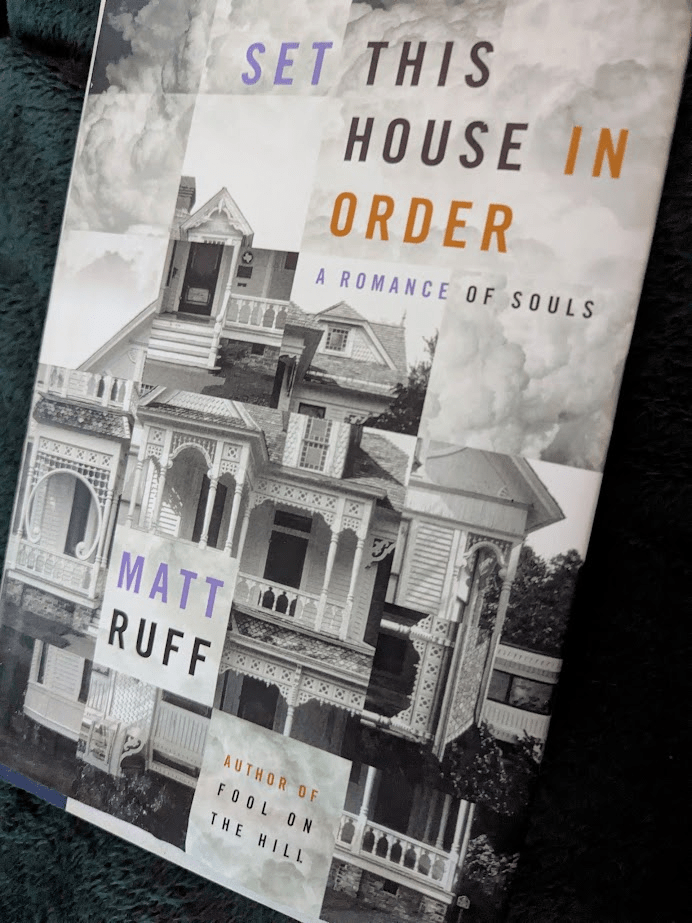
There’s no kindle version (le gasp), so I ordered a copy second hand off Amazon – it said “good condition”, was half the price of new, and it came through pristine – so very happy at that. It was lovely to read a print book again, actually, rather than stare at a backlit screen – I highly recommend it if, like me, you’ve not read anything longer than a birthday card in print in the last [x] years.
—-
The setup
The story primarily follows two people with DID (it frequently uses “Multiple Personality Disorder” because it was written around the time that the language was shifting, but acknowledges DID as the up to date term in the text).
Andrew is the consistent front for the body of Andy Gage, the first protagonist. When we meet Andrew, he’s been alive for 6 months, after being, “called out of the lake” by his, “father”, Aaron (who was the host before Andrew). In Andrew & Aaron’s system, they use the term ‘soul’ for alter/part, and there’s a well maintained structure to how Andy Gage’s souls exist & conduct themselves.
This is all thanks to the ‘house inside’ that Aaron built – but found himself too tired to both run inside, and front for – hence Andrew being called out / emerging to take on the later role, with as little visceral memory of the trauma Andy Gage had been through as possible.
We start off following Andrew’s daily routine, daily life, in his role as the soul that drives the body, with the strict instruction from his father to only let others out at strictly planned times, or in an emergency – and that a big part of his role is to never lose time. And Andrew is proud of the fact that he never has.
That is, until he meets the other protagonist, Penny. Penny doesn’t know she has DID. But she knows that she blacks out, loses time, and wakes up to notes from ‘others’. And those others do not talk / write the way Penny does.
Andrew’s boss, Julie, who is also a friend with… boundary issues (which frequently confuses tf out of Andrew), asks him to try and help Penny to realise what’s going on with her. The fact Julie, a million miles from a trained professional in mental health, is able to just clock this – is maybe a little of a stretch, but there are some parts of the book it’s worth just rolling with.
The way things unfold from there, with Penny asking Andrew to help her build her own ‘house inside’ to be able to get a handle on her own dissociation, is at times a slow, thoughtful game of peek-a-boo between their various souls, turning into a cross-country escapade of losing time, with friendships and rivalries developing, inside and out.
While the level of chaos at times borders on comical, and there’s a certainty and distinctness to their switches 100% of the time (with none of the bluriness/blendiness that can happen for stretches of time) – it’s still relatable for us throughout.
—-
Personal reflections
I’ve done international travel with an ex that felt very similar to this, honestly – where we’d trigger a ‘shift’ (they don’t identify with the language of parts) in each other, and into dissociation, and it was hard to keep up with who was who moment to moment. Not something I want to dwell on – but I certainly think the author hits on something real with his writing, and it never feels like it’s poking fun at the characters.
As for Andrew & Penny’s various souls, I can certainly recognise some kindred spirts in my own system – Maledicta, Penny’s foul mouthed primary protector, reminds me of Jesse in a bad mood (“Like fucking hell you’re shutting me back inside until I’ve had a smoke, cocksucker…”), along with Adam, Andrew’s teenage part who is excellent at reading people, but gets scared whenever he has to actually interact with a girl.
Seferis, Andrew’s part that exercises to a routine to keep his body sharp and prepared to defend the family inside at moment’s notice, and comes forward with calm, honed, assured martial arts prowess when there’s signs of physical danger. Reminds me of Chance’s approach to the physical aspects of keeping us safe & well (while Jesse trains boxing & gets aggressive when we need it – they’re kind of an interesting partnership, in more ways than one).
Loins, Penny’s sexually mature, confident, seductive alter reminds me in some ways of Phoenix.
And Gideon, Andrew’s…. difficult… soul, who has been imprisoned for the last few years inside on the Island of Coventry (a name I love xD). Well, I’m just getting to know my own Gideon, I guess.
… and more besides. None of these are 1-1, of course. There are just relatable aspects. For one thing, my alters aren’t fictional. For another, they’re people with many different qualities, fears, strengths, personalities. But it’s fun to be able to, for example, read about the occupants of Andrew’s house inside, and feel a range of kinships from my own inner world.
There’s also some sex & gender stuff going on, and which is again, sensitively yet matter-of-factly handled. It actually strikes a really good tone for that stuff.
Because, yeah – Riley was born into a male body, with a different name; and now on feminizing HRT & with a passport that says female, and identifies as genderfluid. The way we experience life now includes an inner fam with masc, femme, non-binary, and genderfluid parts / alters. So at this point, the fact that, yeah, sometimes we’re a boy, sometimes a girl, sometimes neither, sometimes a blend, is not a big deal to us – it’s just how it is.
So the ways in which Andrew is, at a couple of points in the story, puzzled or frustrated by other people’s puzzlement about him in relation to gender (with some souls coming to the front calmly aware of why the person they’re talking to is puzzled or uncomfortable, but just don’t feel the need to explain themselves…)… wow is that familiar.
I won’t say more about the story in case you want to read it for yourself – but yeah, can happily recommend.
Trigger warning for betrayal, physical & sexual abuse trauma, and general representations of losing time & inner conflict between parts. It’s never gratuitous or particularly graphic at any point – but if those topics are difficult for you, just something to be aware of.
For us, the scariest thing was when one of the characters starts talking about final fusion – natch.
—-
Useful as a conversation starter
I recently used the book as a jumping off point for revisiting the topic of my own inner world with my therapist. ‘Building a house inside’ is one of the earliest things we did on my journey into all of this, with lil’ Harley being the first to have their own room inside.
One idea I liked in the book, was that Andrew’s house has, “the pulpit”, a sort of balcony where souls can observe what’s going on outside in the world, and easily communicate with whoever’s at the front in the body (usually Andrew).
As my ‘inner geography’ has become more of a forest grove, we’ve now got, “the treehouse”, which is a similar deal to the pulpit – it means I can look inside at who’s close to the front, and nip in and talk to them, without having to go, “all the way in”, and the overwhelm that can come with being in close contact with everyone inside at once.
As you can probably tell if you’ve read past posts of mine, I’m a big fan of being able to use media to communicate about these sometimes hard to grasp concepts. As the book tells a lot of the story from the internal perspectives of the main character – I think it might have something to offer people who struggle with this sort of, “inner world” building that can really help make sense of being, and living in harmony as, a family inside.
Alter
This short film is a wonderful <15 min slice of the DID experience.
This one is particularly easy to recommend because it deals with the everyday experiences that can be part of living with dissociation, without going near trauma as a topic.
It’s a slice of of life of a woman, already in therapy for DID, with a system who does lots of familiar things (journaling, play time for littles), who becomes aware of an alter she’s not yet met…
It’s also about the power of art to allow certain parts to communicate, and how art can allow you to experience your feelings more fully (they do some great work with shifting the frame / aspect ratio when different parts are present…).
It’s very light on dialogue, and more about going on an emotional journey with the main character through their daily life with DID.
There are a few lines that the main character utters out loud to those inside, that are daily staples for us, like:
*trying to do work* “Cummon guys, this is important, where’s my laptop…? … Yeah, I already tried there, thanks…”
*staring through the window for a gallery, then says to someone inside* “Ugh, fine!” *enters the gallery, realizes it’s showing her alter’s paintings*
I’ve parts that love doing art, and it’s a very good way of connecting and experiencing.
So yeah, Alter is brief, moving, and worth a watch.
Petals of a Rose
Another short film, available for free on YouTube, about DID.
In contrast to Alter, this one very much does show the connection between DID trauma.
So trigger warning for sexual trauma – I’ve linked to the version that was specifically edited to have everything graphic or surprising removed, but that’s the topic we’re dealing with here.
One thing it does have in common, is showing that slice of life, going round a grocery store, when a little spots a plush they really want, and the pleading of Rose (the protagonist) asking her to just leave it, promising they’ll play when they get home… (etc)
It turns out it’s a special night for Rose and her boyfriend, and she just wants everything to go smoothly, but she’s really worried that her system isn’t going to deal well with what she’s hoping will happen…
Well, the way her system reacts when difficult memories surface is a kinda familiar one.
I will say, the boyfriend’s reaction at the end of the film is one I’m still waiting for, I guess. The only person I’ve been vulnerable with around my DID while in an intimate relationship… didn’t react well.
I dream of finding someone willing to work together with me while we continue to figure all this out.
The scene at the end, where she’s thankful to each of her alters, is pretty moving & lovely, and what I try to foster among us whenever I’m strong enough.
So plenty here to recommend – albeit this one was much more ‘raw’ for me than Alter.
System Speak
This isn’t a recent one, actually, but I just wanted to shout out this podcast as one of the earliest things I found myself able to listen to, from a system opening up about their own experience of system stuff:
https://open.spotify.com/show/0qPEl3rLBGNerWyrllaPnl
So there you go – a few more recommendations from my ongoing journey through the parts-ier parts of media.
I’ll likely have more of these in the future (at this rate).
Until next time, take care of yourselves, kiddos ❤
Riley & fam
 Three Kids in a Trench Coat
Leave a comment