

Right up front here – hopefully this’ll be accessible to both people who’ve played the game, and those that haven’t.
But if you haven’t played it or finished it yet, disclaimer for the fact that there are gonna be spoilers for the whole story.
—
Clair Obscur: Expedition 33 is a video game released earlier this year for PC, Xbox, and Playstation, by new studio Sandfall Interactive. It’s a really fun, well made game, the type I love – a JRPG style, turn based combat, with interesting timing / skill based elements.
Made by a predominantly French team, with an incredible soundtrack, full of French operatic vocals that seamlessly blend with heavy rock guitars. The visuals are exquisite and fantastical, with amazing cinematography that’ll give visual theory nerds plenty to chew on.
It’s also the most heartstring-tugging examinations of grief I’ve seen in any game before… perhaps that I’ve seen in any medium anywhere.
—
Clair Obscur – the contrast of light & shade
The term, “clair obscur” is a French translation of the Italian term, “chiaroscuro” – both used to describe a particular style of art, common during the Renaissance & Baroque periods. It refers to the use of extreme contrasts of light and dark, to create depth, draw attention, unsettle… it can be used in many ways. It was favoured by artists such as Leonardo Da Vinci, Carravagio, Renbrandt, and… Renoir, a name you’ll be familiar with if you’ve played the game, regardless of your knowledge of art history…

The premise
To recap the whole plot would be an exercise in madness – there’s a lot going on here. But to set the stage with an early recap…
The opening 10-20 minutes set the world and the premise out beautifully. Our early protagonists, a 32 year old man (the age matters), and a teenage girl, Maelle, are standing atop a building in an otherworldly version of what looks like Paris. There’s even an impossible, bent Eiffel Tower in the distance.
Far across the ocean, a giant, obsidian monolith, with fragments of rocks suspended in the sky all pointing towards it, has the number, “34” painted across it in brilliant, white-gold.
We learn, through some extremely heart-wrenching storytelling, that each year, a giant figure under the monolith rises, erases that number, and paints a new number – one less than it was the year before. Today is that day, and as “34” is erased to become, “33”… a portion of the town’s population just… disappears. They fade to dust and a flurry of red and white petals, blown away by the wind.

It turns out, everyone that age and below when the number is painted, is claimed by the “gommage” – the French for, “erase”. Gustav’s love Sophie is one of the people claimed, as they stand in the harbour, surrounded by other vanishing souls – holding each other’s hands. “I’m here” Gustav says. “I know, I know…” Sophie replies through her tears… and then she’s gone.
Loss. Grief. This is just the start of a story that will come back to this theme time and again.
—
There’s a inevitability that everyone’s just accepted here in the city of Lumiere. Everyone, that is, except for the Expeditioners.
Each year, many of those with only one year left until their own gommage, depart on an expedition to journey across the ocean and try to stop The Paintress, the figure under the monolith painting death.
Or at least, that’s what we’re led to believe for the first 2 acts of this 3 act narrative.
The turn
As we follow Expedition 33’s exploits, we meet a man named Verso. Apparently, he’s around 100 years old – he came to the continent with Expedition 0, around 77 years earlier. And, it seems, he cannot die.
He becomes the party’s leader after Gustav meets an untimely end to a white haired man, around 50 or 60 to look at him, who wiped out almost all of Expedition 33 the moment they landed. More loss. More grief. Gustav was an adoptive father to Maelle, and as she puts it, “the best father and brother I’ve ever had”.
Well, it turns out the white haired man, Renoir, is Verso’s dad. And they’ve got a bit of a family spat going on. They cross swords (well, sword and cane), several times in Act 2.

Verso leads Expedition 33 to successfully take down The Paintress. It’s done. It’s over. No more painting death. No more senseless loss of life back in Lumiere. Our heroes return, greeted by a warm, smiling crowd of people who have been given back their futures.
And then, from under the monolith, an explosion of red energy.
And everyone in the city is gommaged (by Renoir as himself – it turns out the version you’ve been fighting was painted by The Paintress) at once.
Everyone, that is, apart from Verso.
And Maelle.
An inner world with a twist
We wake up as Maelle, well, Alicia, sometime in the recent past. Well, recent past in the “real world”, that is.
It turns out that the world we’ve been inhabiting these last 20 hours of gameplay or so is, in fact, a canvas world painted by Verso. Or Verso’s real world counterpart. His family are, “Painters”, which in this universe appear to be people who can create these canvases that can contain whole worlds, that they can step into – and live among the inhabitants, who have their own lives, thoughts, feelings, beliefs… people who believe they are real, and in so many senses – are real, within this world.
Essentially, the canvas we’ve been inhabiting this whole time is Verso’s inner world. He even has representations of his childhood plush best friend, Esquie, who in the canvas is a lovably slow and silly demi-god, and his dog Monoco, painted as a gestral (a race of child-like paintbrush creatures).
In many ways, Verso’s canvas resembles a rich, detailed, vibrant inner world of someone who sees wonder everywhere, with the real world of his life represented in fantastical new ways.
But there’s a big twist to this.
Real world Verso is dead. He died in a fire saving his sister Alicia.
And so, with this world created by Verso being all that remains of him, his mother, Aline, entered the world and created ‘perfect recreations’ of her family, including Verso, within the canvas.
She loses herself in the canvas, refusing to face the grief of losing her son, and escaping into fantasy. Renoir, her husband, enters the canvas to try and persuade her to come back to the real world, and be with the rest of her family, who both need her and love her. But she refuses. So Renoir starts trying to erase the canvas from within. So Aline traps Renoir beneath the monolith. Renoir traps her at its peak.
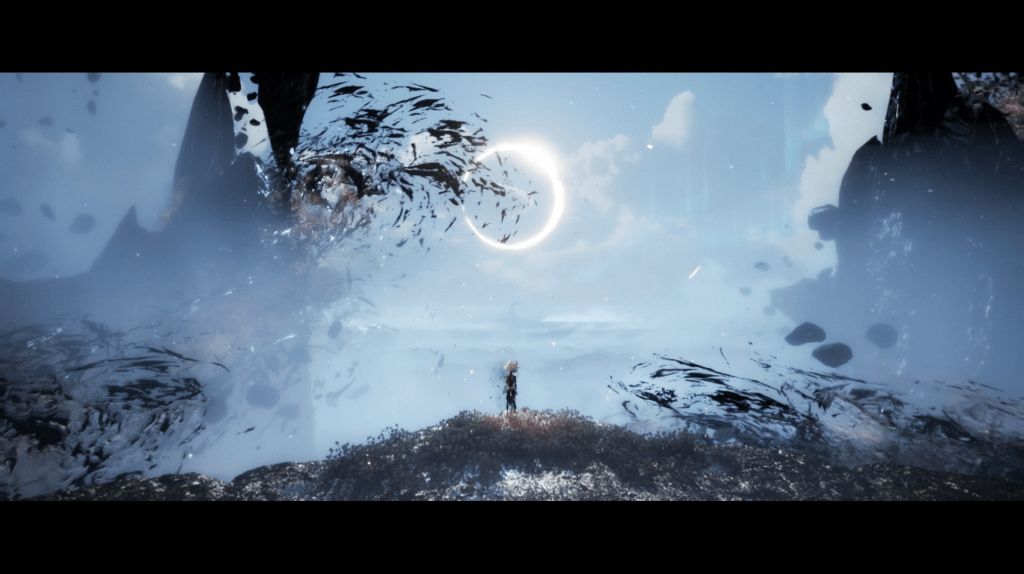
A war to erase, staved off by Aline as The Paintress, saving as many people as she can each year, painting the number on the monolith as a warning to all those who will be beyond her power to save, begins. That was 77 in canvas years ago. That was The Fracture.
Alicia’s Alter: The story of Maelle
Alicia is burned, scarred, and has lost her ability to speak in the real world. She enters the canvas to try and help her father Renoir bring back her mother Aline, but the plan goes wonky and she is born into the canvas as one of Aline’s creations, to parents who soon die due to the gommage.
Named Maelle by her parents, in this world, Alicia has no scars, no burns, still has her voice. Until the end of Act 2, she has no explicit memories of being Alicia at all. She has, in effect, complete dissociative amnesia for her trauma.
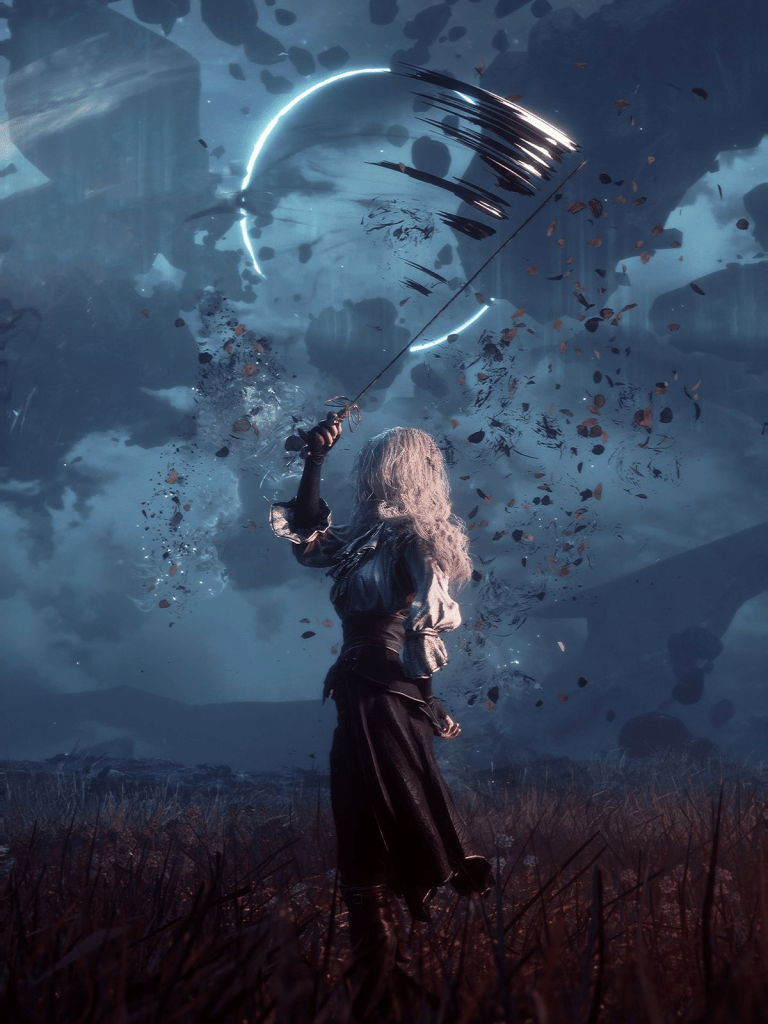
But Maelle never really feels like she fits in with the others in Lumiere, either – unaware that she is, in many ways, the alter of a person who has experienced extreme loss.
But, once she reaches the continent with Expedition 33, she starts having visions. Nightmares. She starts recalling glimpses and screams from the fire. She gets somatic flashbacks to being on fire.
These kinds of somatic experience are really common in DID. Like, really common. It can feel like parts of your body disappear, only to experience extreme pain when a part that holds pain from the past comes back into awareness, perhaps only to be shut back out when that pain quickly floods or overwhelms the system.
Literally part of the diagnostic process for DID can be exemplified by things like the Somatoform Dissociation Questionnaire 20 (SDQ-20), which includes questions like:
“It is as if my body, or part of it, has disappeared”.
“I cannot speak (or only with great effort), or can only whisper”
“I am paralysed for a while”
“My body, or a part of it, is insensitive to pain”
It’s often not these symptoms that bring people into specialist dissociation services, but instead what happens when dissociation becomes patchier, when parts carrying a lot of pain come back into awareness when the dissociation is no longer, “needed”, so the part can process – but cannot process fully because the person’s experience of themself is too fragmented a whole. These are the kinds of tangles that therapy with a dissociation savvy therapist can help a person to gently, slowly, compassionately untangle.
Maelle is in the middle of a war, with herself, with her family, with her anger at the worlds, both painted and real – in her eyes, she does not have, or want, to be able to process the pain of all the loss that the fire brought her as Alicia outside the canvas.

This type of somatoform dissociation and sensory flashback are most common in something like DID, where dissociation is a part of life since a very young age. But it brings us onto something that gets to the heart of why Clair Obscur: Expedition 33 feels so relatable in terms of dissociation whether you have DID or no dissociative disorder of any kind…

Clair Obscur’s Depiction of Depersonalization / Derealization
I think one of the reasons Clair Obscur resonated so deeply with me, beyond the raw emotional content of the story (and it’s an amazing, heart-wrenching story entirely in its own right), is the way it portrays dissociative aspects of grief.
Grief is often a huge emotion. It’s usually too big for most people to process in one go. “Everyone grieves in their own way; it’s a process” is something of a maxim to which there’s a lot of truth. It’s entirely normal for people, after the loss of someone very close, like a parent, child, partner, etc, to experience some symptoms of dissociation as they process the loss a little bit at a time.
This isn’t a disorder. This is an example of how dissociation is an entirely normal mechanism in the human experience, that protects us from complete collapse in the face of overwhelming emotional pain.
Two things people experience after traumatic loss are, “depersonalisation” and “derealisation”.
Depersonalisation is, in essence, feeling that you, your body, and/or your feelings aren’t ‘real’ – that you aren’t real. You feel disconnected from yourself.
Derealisation is, in contrast, the feeling that the world around you isn’t real. People, places, things, that should feel familiar, feel strange, alien, otherworldly… ‘wrong’ (like The Truman Show). You feel disconnected from the world.
While Depersonalisation and Derealisation (DP/DR) are normal for everyone to experience at some point(s) in a person’s life – they can become a long term problem, and are also usually ‘baked into’ the everyday experience of more complex forms of dissociation like DID & OSDD. So, I’ll give a couple of quick examples from my own experience (so these are a bit more DID flavoured):
With depersonalisation, I frequently find myself experiencing my feelings as though they are not mine – that they instead belong to one of my alters. Or I may become surprised when someone tries to get my attention in my environment, because I “forgot that I actually exist”, with a body that other people can perceive, rather than being a dream of a person. A lot of my childhood memories I can recall as still images, with very little emotion – even the things that Sucked. I often feel like my alters / parts are more real than “I” am.
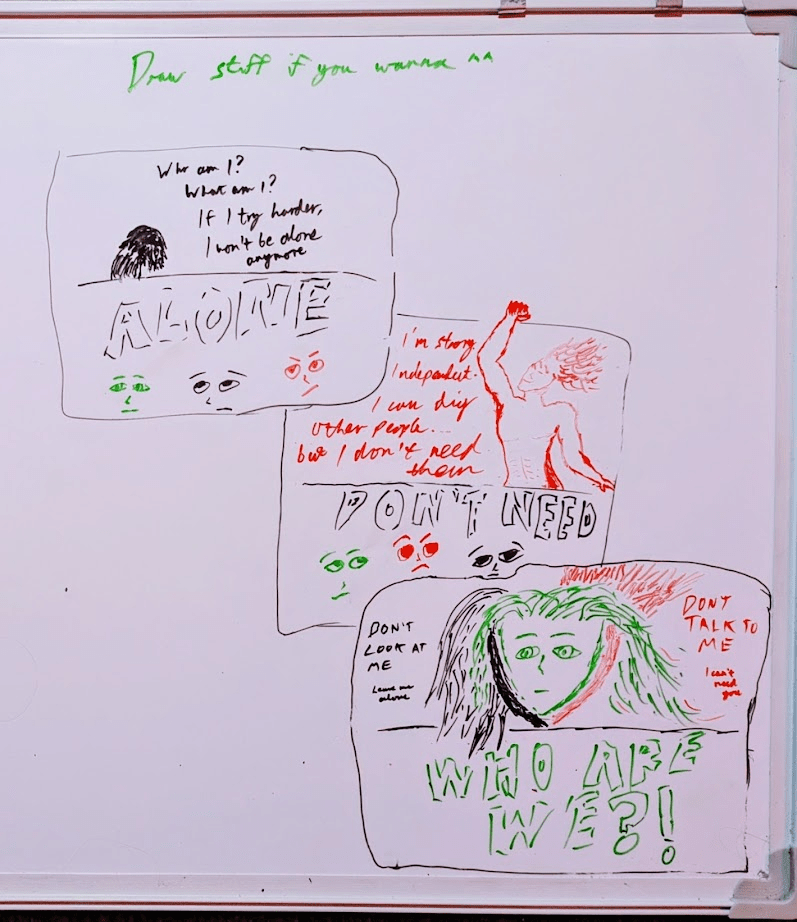
I’ll contextualise that in terms of the story shortly, but derealisation is a more straightforward comparison here:
Sometimes, when one of my little alters is out front in a non-negotiated way (usually due to a trigger), the world often seems huge. Like, if they’re out in public, people can feel three times taller than me, the buildings around me can look like they’re miles away, rooms feel expansive and enormous.
While we’re experiencing derealisation, the geography & architecture of the world can look impossible, almost non-Euclidean in nature. The world can seem to be so brightly coloured & contrasting it hurts our eyes, or almost monochrome (depending on which alter is out). My environment, and other people in it, don’t feel real.
Yet when adult parts become present again, things can ‘snap back’ to where I’d normally expect them to be. This happens often enough, that after a while this just began to feel like a normal part of our life.
Well, perhaps you can see the relevance of all this to Clair Obscur… In the game, you are constantly surrounded by the impossible, “familiar but strange” landscapes. Lumiere is almost immediately recognisable as Paris, from the architecture, clothing, the presence of the Eiffel Tower. Yet the Eiffel Tower is warped and bent in structurally impossible ways. The city itself is, in places, bent, broken, fractured.

As you look over the sea to the monolith, the number painted on it, the halo of light that surrounds it – the white-gold is so brilliant as to sear itself into your eyes. And yet the whole scene is virtually monochrome.
As you explore the world, Verso’s canvas is filled with brightly coloured impossibilities – upside-down manors, bits of geography taken from one place and transposed into somewhere alien… One of the first places you visit is, “Flying Waters”. It’s like you’re under the sea, surrounded by fish, bubbles, it looks like you’re in a brilliantly colourful seascape. And yet, you can breathe, move freely – everything around you isn’t underwater; it’s flying.
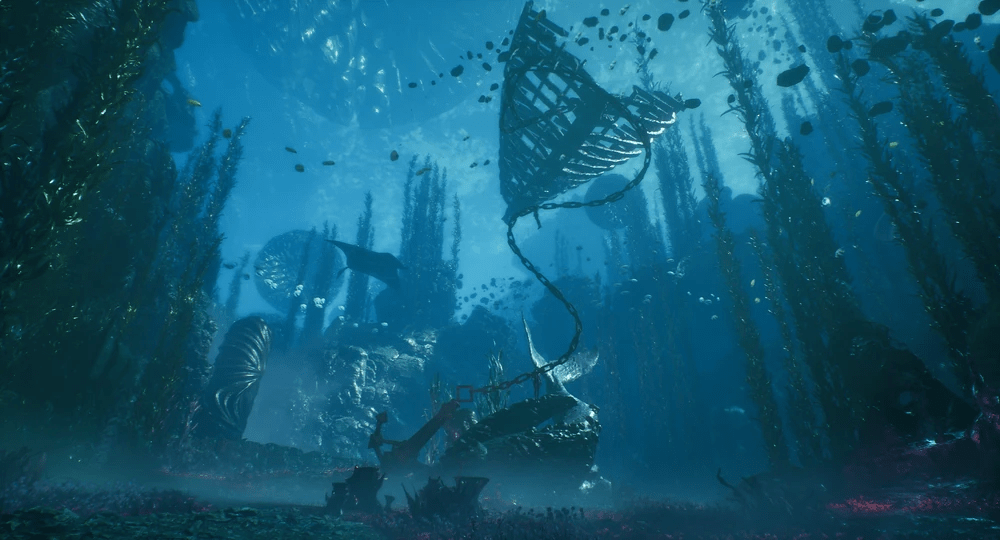
Immersed in this world, you lose the expectation that things will, “snap back” to usual. The bizarre becomes normal.
Nous peindrons le Clair Obscur (we will paint the Clair Obscur).
This is what derealisation can feel like.
Depersonalisation on the other hand… well…
Wait… didn’t we die already?
… is what I found written in our journal one day. Maybe more than once, actually.
It’s not entirely uncommon, I gather, for some DID systems to have at least one part that believes they are dead, or that they don’t have a body. This part being close to the front & to awareness is very much a depersonalised & depersonalising experience.
In Clair Obscur – in Verso’s case – he doesn’t have a body, out in the world. He did already die. Painted Verso is referred to as, “All that’s left of Verso’s soul”. And he is acutely aware of this, from the moment you meet him. He knows that he is dead in the real world, and that he is being forced to live out this ‘fake’ existence – an existence he does not want.
This plays out in the games ending, and the choice that you must make in the final moments of gameplay – more on that shortly.
But as you may be able to imagine – I have a lot of empathy for painted Verso.
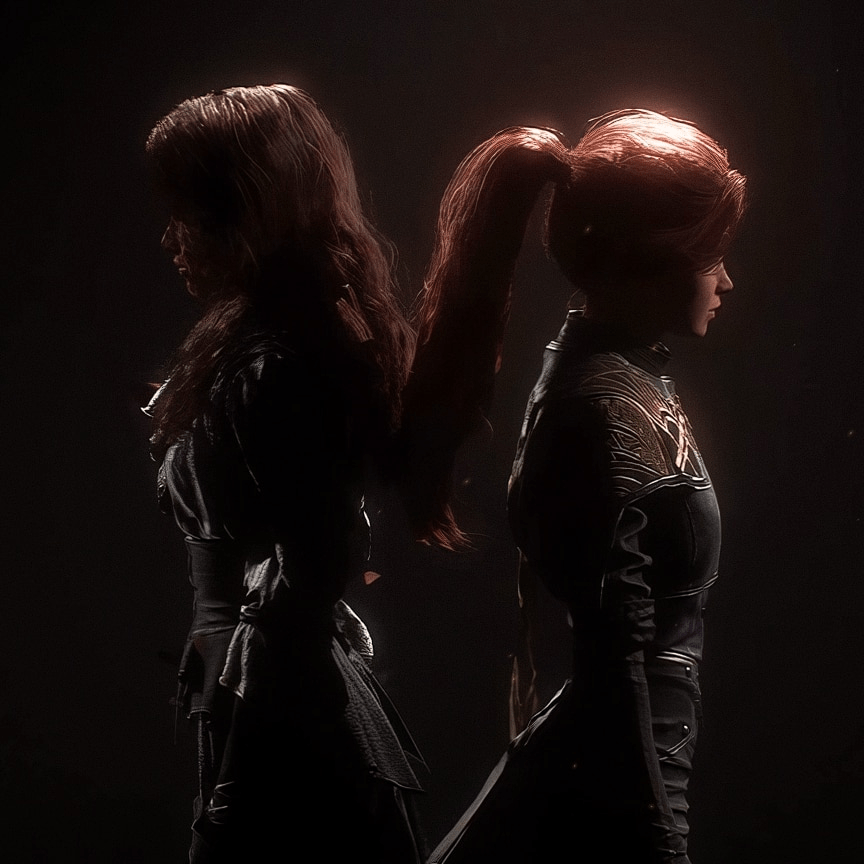
In contrast (there’s the theme of clair obscur, light & dark, again…) Maelle, in the canvas, feels most “her” when she is occupying this painted, inner world version of herself. She doesn’t identify with the bodily and emotional pain that she experiences out in the ‘real world’ as Alicia. By Act 3, she knows she still has a body, but it’s a body she doesn’t want to know, and will fight like hell to stay out of.
She is Maelle – a teenage girl, who didn’t almost die in a fire, who has her voice, her unscarred face, her older brother still alive. She experiences the painted, “inner world” as more real, and certainly more desirable than the world outside.
Maelle wants to live in this canvas, and remain separated from her still living and breathing body. Verso, to join his body in death, and to find rest, to find peace at last.
Dissociation is part(s) of ourselves protecting us from the things we believe are so awful that we wouldn’t be able to cope with them. Sometimes, what is so awful to us, is just.. ourselves as we are… the world as it is… all of it.
That’s the impact of trauma & the beliefs that can embed themselves as an aspect of it.
Maelle’s experience is what DID in the present day can be like for so many people – and one of the reasons why a conversation that comes up for me in therapy from time to time is, “It’s important to visit the inner world, to be connected with it – but not to live there exclusively full time.”
I literally struggle with this exact dynamic that Maelle / Alicia is struggling with on a daily basis.
Back in the game, at times, we see Maelle being curious about Alicia when she meets herself as her mother paints her in the canvas (masked, virtually voiceless), and eventually developing empathy for her – but she wants to release her from her pain, and to go on living as Maelle here in the canvas.
She believes herself to be more real than the girl who is up there, out there in the ‘real world’ somewhere, with no voice, a scarred face, and all the feelings of a lost future that go with her unprocessed grief.
(incidentally, I’ve also found notes in our journals about having no face, or being unable to speak – again, very depersonalised experiences).

The Choice
The ending to this game destroyed me.
Having been ride or die for Maelle, and her position, taken up against her father Renoir, that she should be allowed to continue living in this painted world, with her friends (who real Renoir absolutely acknowledges as people)… we come to a (sort of) surprising turnaround that stopped me in my tracks.
Verso does not want to go on living, and in undoing himself, would end this world.
And I wanted to give him that – in spite of everything it would mean.
He does not want to keep being painted back to life, over and over – he wants to end it all. He’s experienced 100 years of torment in this canvas, and he doesn’t want to go on.
I chose to side with Verso (but also went back afterwards to see Maelle’s ending, too. I think I chose right the first time…)
As Verso convinces his child self to stop painting, the world is unmade… the heart of the inner world stopped, and all the creations in it, one-by-one cease to be.
This ending was hard, because we’ve come to know and love these characters, and even though this allows Maelle and Aline to return to the real world to grieve with each other, and the rest of their family (father/husband Renoir, & sister/daughter Clea), it means the end of the lives of everyone else in this bizarre, shared ‘inner world’ that has been Verso’s Canvas.
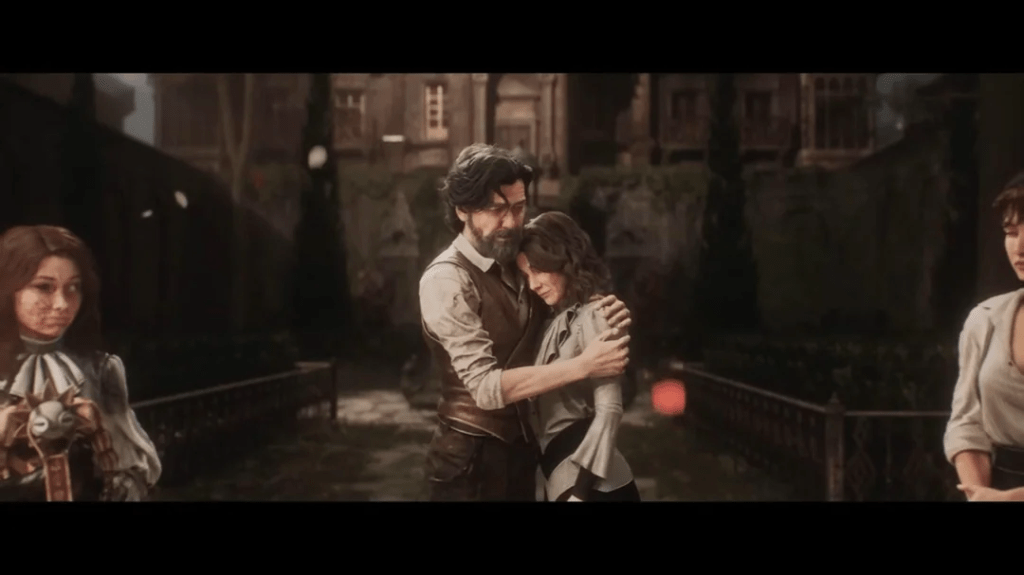
This was also really hard for us, because there’s something about having, “people inside” that can change how you see life and death, and the prospect of ending your own suffering. Because you feel like you’re not just responsible for your life – it’s like you’re responsible for the lives of everyone else inside, too. Sure, we’re all parts of one person – but, at the same time, everyone in here is unique, and has their own memories, their own perspective, their own sense of, “I”.
Maybe I’ll be able to write more eloquently about this another time, but right now, it’s hard to think about.
It brings up so much for us, and sometimes you just need to listen to the, “Enough, for now” coming from inside.
Dans chaque colouer, une part de lui
There’s some great music in this game, and so I’ll end with some of the the lyrics to Une vie à t’aimer (A life of loving you):
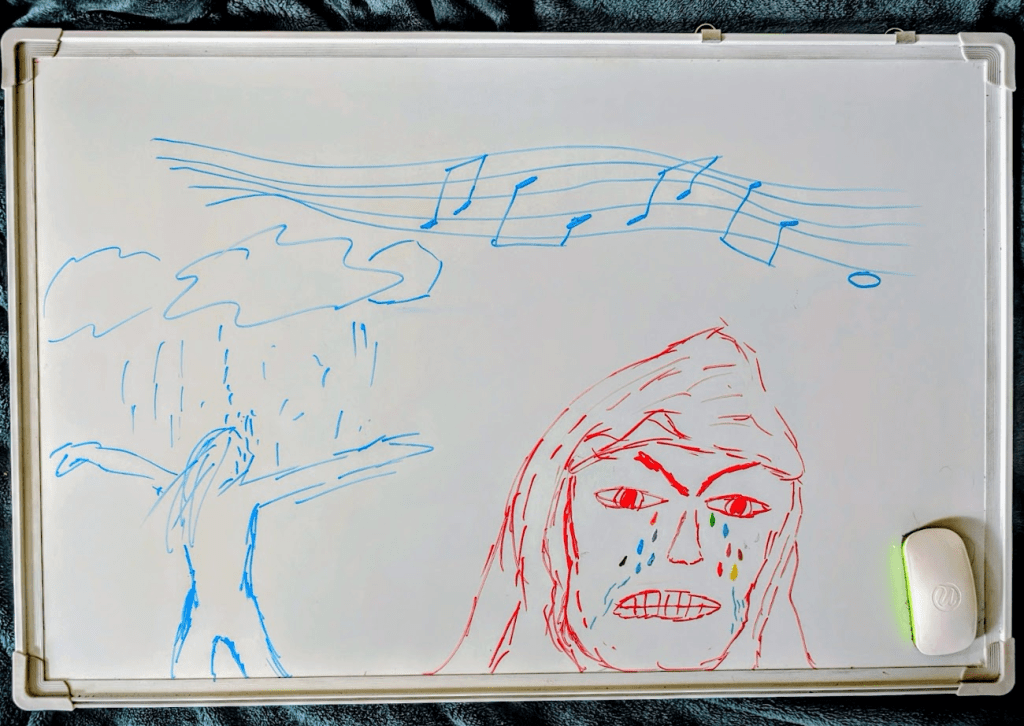
Colours ablaze
Fire red, a life taken away
A painting I cannot see,
Closing my eyes, only black remains.
In black, his sad eyes,
Through gold, his laughter lingers –
In every colour, a part of him.
Ever loving him, even though he’s no longer here.
Painting love,
Painting life;
Crying in colour.
(Aline) On the canvas, our love’s enduring / (Renoir) On the canvas, our love’s ending
I love you.
—-
Until next time – take care of yourselves, kiddos.
Riley & fam
❤
 Three Kids in a Trench Coat
Leave a comment