We’ve worked in the field of psychology & health research for over 15 years.
Well, now we’re getting involved in a slightly different way – by participating in a study being led by researchers at the Institute of Psychiatry, King’s College London (KCL). It’s on sense of self and self-related processing in DID – a topic that over the last year in particular has been… highly salient, shall we say.
We give a brief outline of the study below – and talk about something (I gather) a lot of DID systems have a complicated relationship with; diagnosis.
What’s the study?
The study is called PREDICTSELF, and is currently running in the UK at the Institute of Psychiatry, Psychology & Neuroscience (IoPPN) at KCL. It’s already started, and is running for up to another year of recruitment, and then another year or so of analysis & reporting etc. The Health Research Authority have a brief summary here, along with confirmation that the study was approved by an NHS Research Ethics Committee (REC) last Feb.
As we live in London, the researchers seem passionate about the topic & supporting people with DID (as are we)… sense of self has been a really big challenge for us this last year… and the fact we’ve been a Visiting Lecturer at KCL for a decade, it felt like the universe was nudging us along.
All in all, an easy decision – time for a fam outing!
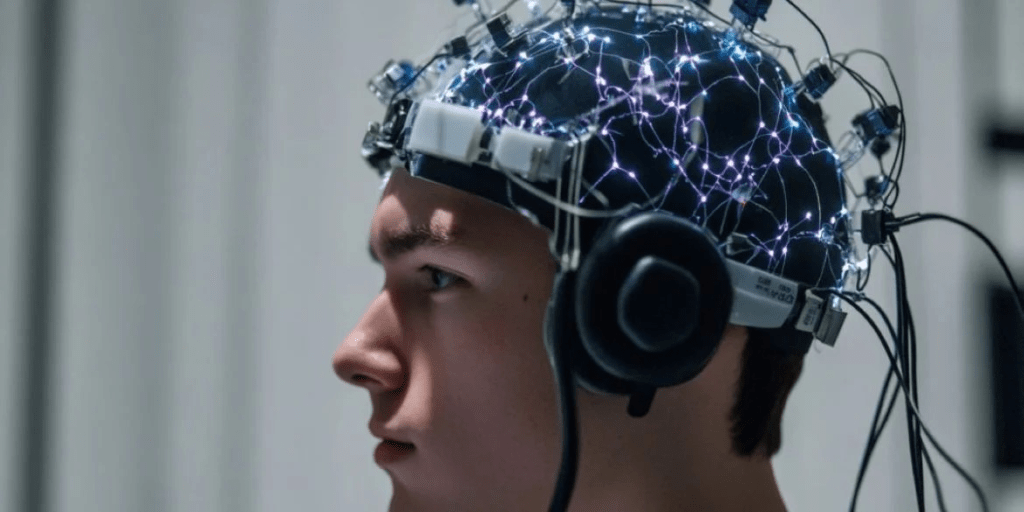
The study itself involves answering various questions and completing some experimental tasks at the IoPPN labs, some of them while wearing a sexy electroencephalography (EEG) cap (below). The researchers, wisely, don’t want to give everything away about the exact tasks or hypotheses for each. I could probably figure most of it out in advance (I’ve designed a lot of clinical research, and, as you may be able to tell, also think about DID a lot). But – I’d rather help them out by just waiting & finding out by doing.
A EEG cap. Gonna be difficult to match my outfit to this one, but Phoenix loves a fashion challenge…
I do know at least one of the tasks involves photos of us, and also (I assume) photos of a friend. They asked us to submit 15 photos (from the last 8 years, face clearly visible) of ourself(ves), and to have a close friend send 15 of themselves, too. We have plenty of photos, but it took a little while because most of us wanted to have at least one photo in there ^^
A few of the photos we submitted – including Chance presenting some of our research at UCL’s Digital Health Behaviour Change conference ^^
The aim is investigate the sense of self in DID. For the sake of the study, they’re doing the same procedures with two other groups of participants; people with PTSD (without DID), and people from the general population without clinical levels of trauma or dissociation.
It always takes a while for results from participation to be collated, analysed, and translated into findings & journal publications. But, after the study is complete, you’ll be able to read all about it – along with some (hopefully!) juicy results helping us understand a little bit more about sense of self & processing self-related information in DID.
I’ll probably have a lot to talk about when that happens!
Before we begin… Screening & diagnosis
This is also a good opportunity to talk about the… sometimes lively… topic of diagnosis in DID…
The researchers have already talked to my trauma & dissociation specialising therapist, who I’ve been working with for the last 2 years – and he’s very supportive of me participating. However, he also works transdiagnostically (as many Psychologists do, in contrast with Psychiatrists), so despite working to the ISSTD guidelines on DID together, & the fact there’s no way anyone could get to know us so well in a day – I need to go through the joyful process of diagnosis, for research rigour. It’s a fair cop.
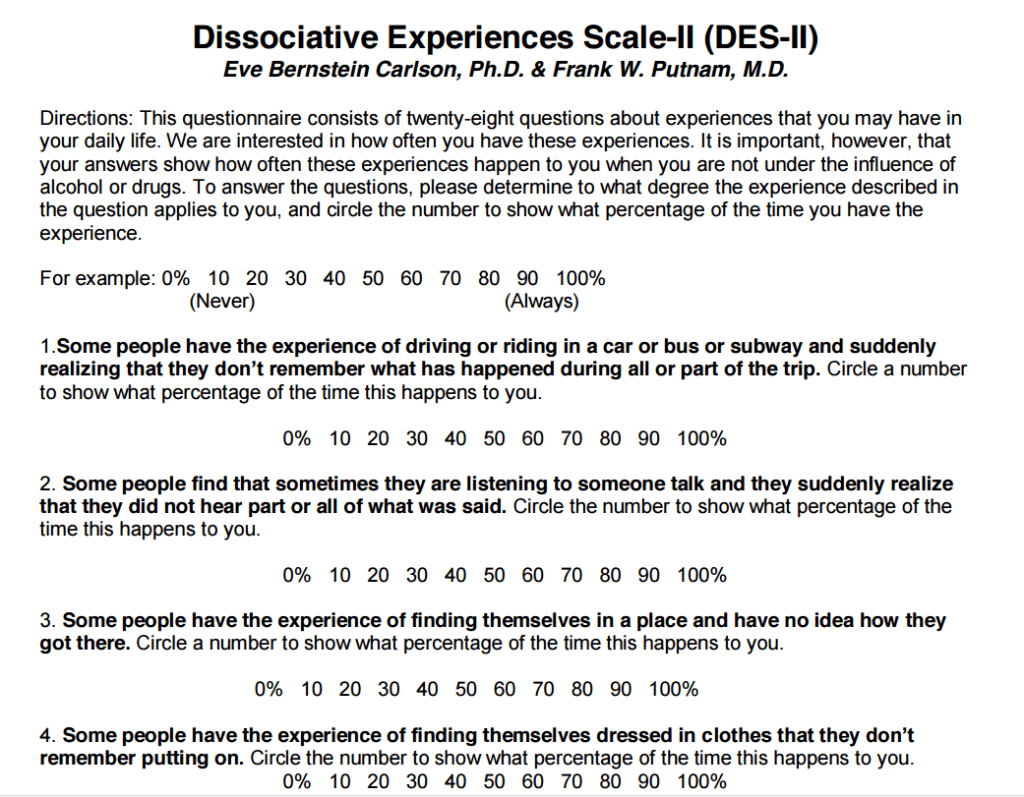
So… I’ve read the information sheets, signed the consent, sent the photos (& a close friend has kindly done the same)… and, ahead of the 4-hour in-person SCID-D interview – I’ve completed the Dissociative Experiences Scale (DES) II.
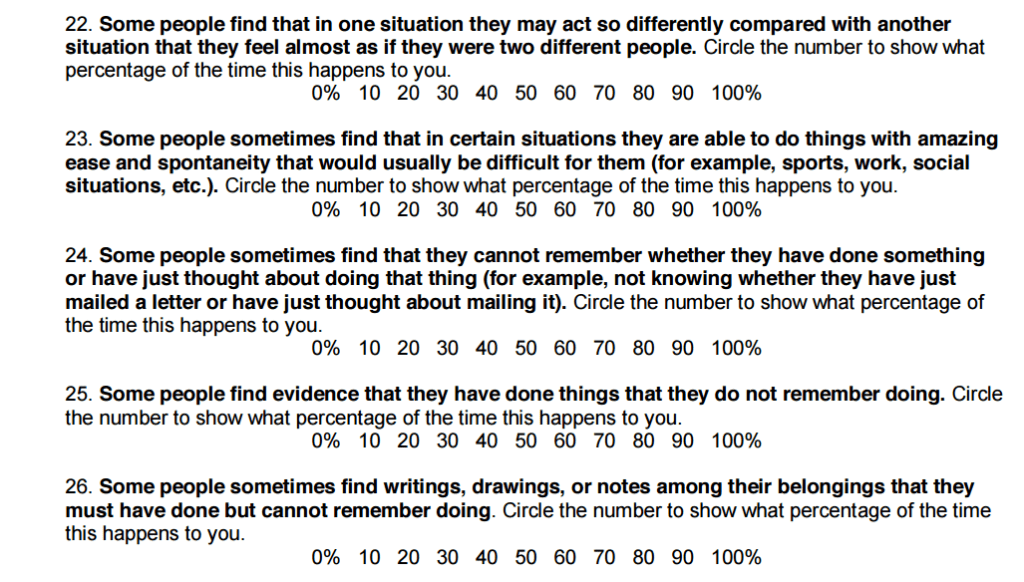
The DES-II is a 28-item screening measure, that maps to the 5 major DSM ‘types’ of dissociative experience (along with a couple of items on ‘everyday’ non-clinical dissociation, like highway hypnosis & zoning out during the odd conversation). The 5 types are:
Depersonalisation (e.g. I don’t feel real, I feel disconnected from my body)
Derealisation (the world doesn’t feel real, other people don’t feel real)
Dissociative Amnesia (losing time; not being able to remember significant people, events. or how you got somewhere)
Identity Confusion (my sense of identity is blurry, I don’t know who I am)
Identity Alteration (I feel like there is more than one person inside; I feel like different people)
Each item has a simple 1-sentence statement, and asks you rate each for proportion of the time (0% of the time to 100% of the time) that applies to you.
=======
Example items from the DES-II
If you don’t consider yourself dissociative & answered a few of those positively – don’t worry. Like I say, there are a few, “everyday” experiences in there, and averaging at least ‘30% of the time’ across all items is indicative that it may be worth further assessment for DID.
Like I say, it’s a screening tool, meaning it’s intended to give an indication, not a diagnosis.
Diagnosis is assessed through a 4 hour interview, in this case with the lead Clinical Psychologist on the study, using the Structured Clinical Interview for DSM Dissociative Disorders (SCID-D). We’ve got that to look forward to next month.
That involves many, many questions, and follow-up probing from the clinician, on those challenges above & more, along with assessing broader mental health & functioning.
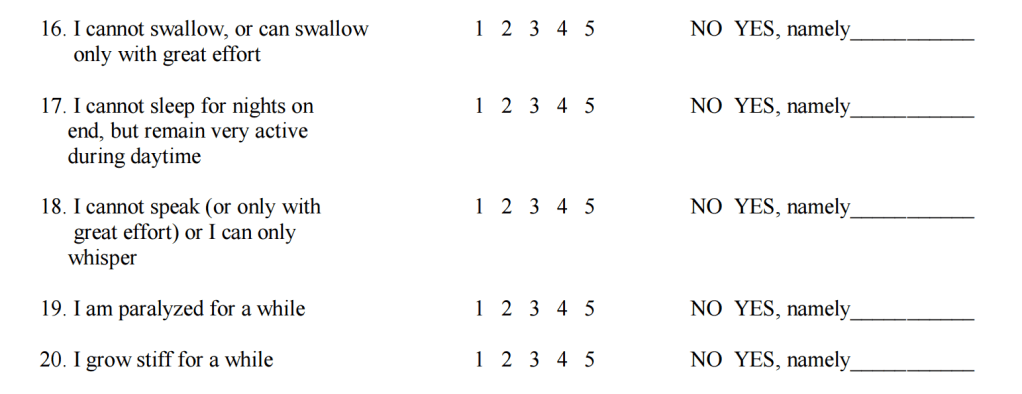
It also involves questions on somatoform symptoms of dissociation – things like groin & digestive pain, changes in perceptions of the size & colour of surroundings, numbness, paralysis, finding yourself unable to speak, and being unable to sleep at night while remaining active in the day.
Sound irrelevant? – Well, the Somatoform Dissociation Questionnaire-20 (SDQ-20) might as well have a, “Yes to all” option for us (more or less). The items included are commonly experienced alongside dissociation. Anyone who says DID is, “all in your head” is being very optimistic – honestly, it’s the body stuff that causes us more dysfunction than anything else.
Example items from the SDQ-20
Given I’ve been working with my T&D specialist therapist for 2 years now, he’s spoken with my parts, with and without me, taught me how to call parts forward & remain with them… he’s (extremely capably, patiently & kindly) humbled me when parts have come forward to challenge his knowledge & skills (and I’ve come back to the room with a sense of, “Oh no… not again…” – fortunately we got over that phase eventually, after enough integration to realise, “Holy shit – he’s been working with all of us this whole time?!”).
He’s helped me be less ashamed of the lost time & amnesia, and welcomes all of my parts in words & actions. He helps us to look after each other. We trust him with things we never thought we’d trust anyone with.
So the idea of covering all that face to face with a new person in an interview setting is a lot.
I mentioned a lot of systems apparently have a complicated relationship with diagnosis – and that’s certainly been true for us at points in the past, particularly the first year.
Talking about dissociation can be triggering, especially when you’re answering questions face-to-face (rather than writing about it at your own pace – hi!) Add to that that some parts may think diagnosis is very important, while others want to remain undisturbed… while others still don’t believe they have DID, parts, or trauma at all… (with all parts just taking different approaches to trying to keep us safe…)
It can all get very noisy, as you try to just answer as best you can.
We found this question hilarious – I’ve left our response in so you can see the enthusiasm behind that one xD
Anyway – research rigour demands standardisation – so this is just something we have to grin & bear, as honestly & openly as we can, while looking after ourselves & each other.
We’re more used to talking about this stuff now… and writing this blog has partly helped with that. It’ll all be worth it – and if anyone’s learnt anything helpful about the screening & diagnosis process reading this – then it already is.
Until next time – take care of yourselves, kiddos ❤
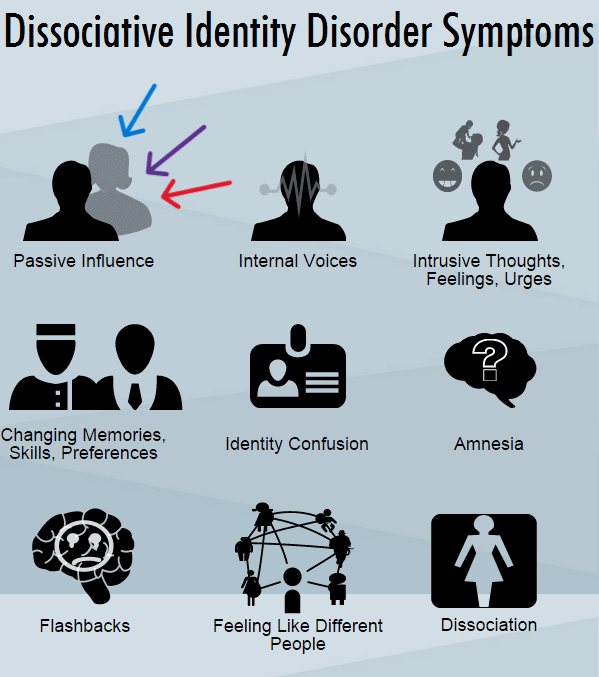
In the dissociation & parts lingo, you might hear people talking about something called, “passive influence”. This is where a part that isn’t currently “fronting” influences the part(s) up front through thoughts, behaviours, urges, sensations, etc.
These influences may be experienced as, “ego dystonic” – i.e. as not arising from oneself. Sometimes, you might come up with one explanation for why you’re doing something to avoid that dystonic experience, without realising that’s what you’re doing.
Here’s an example of the latter from today:
—
“Just stretching my le… oh.”
This morning I went to the corner shop to get a fresh vape – a 1 minute walk to the end of the road.
I came out of the shop and thought, “I feel like stretching my legs some more, so I’m just gonna keep walking. Maybe I’ll go to Ally Pally park.” – a very familiar walk indeed, we go at least 2-3 times a week.
So I started walking that direction. Then got the urge to turn off pretty quickly. “Ok, let’s go this way & keep walking – haven’t been this way before, let’s see where this goes!” We keep going. Another unfamiliar turn, walk, turn, walk, all down unfamiliar roads.
“Oh I know this place! If I turn off here we can get to the park this way…” Start going that way. Nope, not where I thought we were. We turn off again, walk, turn, walk. “Oh, this isn’t the right way at all, this is…”
“Wait – why are we at our dentist’s surgery?”
Yup, set out for 2 min vape run, and ended up 30 mins out of our way at a place I didn’t think I had any reason to be. Checked our fam Trello board:
Apparently we were supposed to call to make a dentist appointment this morning & I hadn’t been checking the board – so the part that left the note walked us there instead. Well, message received, now.
At no point while I was out did I feel like there was any shift in identity, and was present with my surroundings and the sensations in my body, my thoughts, feelings. No fugue, amnesia, switching, nothing like that. Sometimes parts just passively influence from behind the scenes, and it’s just another type of communication to be open to.
Parts taking the drivers seat if needs go unmet is a whole thing, and dental care is something I’ve been avoiding for a while, but they’re right – we need to go, however scary we find it.
I’m going to message the practice after lunch, and include a note about dissociation, as we haven’t been since we learned about it, and dissociation explains a lot about our relationship with dental stuff over our life so far.
I really should get better about checking our shared message spaces more regularly It would have been much easier just to message or call this morning xD – but I also appreciate my fam looking out for our body ^^ ❤
Until next time, take care of yourselves, kiddos ❤
It’s ok to have a dissociative Christmas, if that’s what you need ❤
The holidays are a mixed bag, for us.
We used to love love love Christmas, and I think, we’ve continued that enthusiasm throughout most of our life.
There have been exceptions, and last year was a really, really tough one. Last Christmas was one of the hardest days of my life (that I can remember – which admittedly narrows things down a bit…)
C’est la vie – whether singlet, plural, cis, trans, whatever your religion, agnostic/atheist, inclined to be by oneself, or around others – the holidays can be tough, as well as bright and merry.
We’ll be spending this one surrounded by people we love again, and hopefully a lot of the particularly confusing relational circumstances that were very front & centre last year are a lot simpler this time around.
Whatever your situation, wherever you find yourselves – we wish you all the best this Christmas & New Year, and hope y’all get whatever it is that you need to feel a little warmth & joy inside. Everyone deserves that.
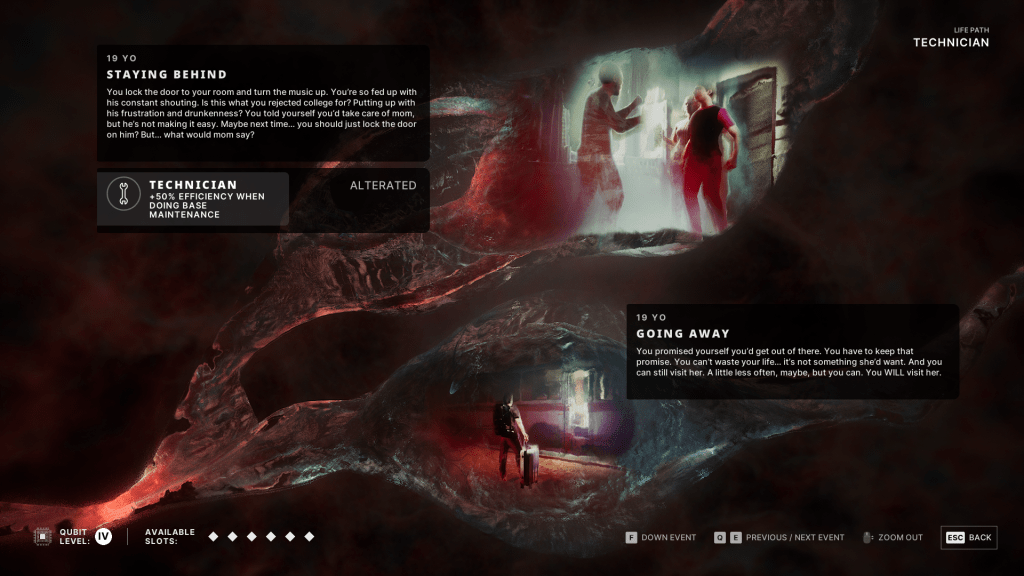
Right up front here – hopefully this’ll be accessible to both people who’ve played the game, and those that haven’t.
But if you haven’t played it or finished it yet, disclaimer for the fact that there aregonna be spoilers for the whole story.
—
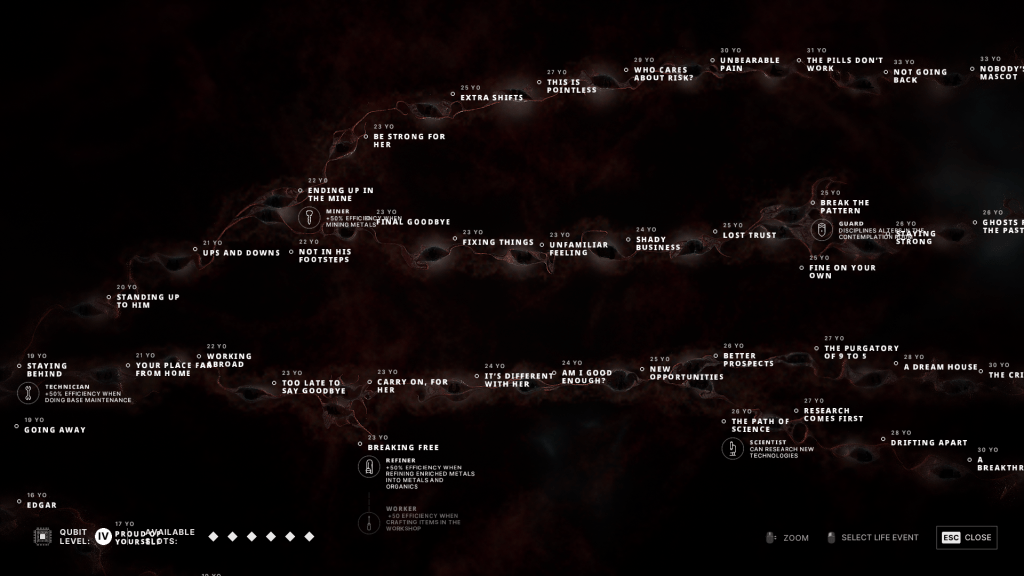
Clair Obscur: Expedition 33 is a video game released earlier this year for PC, Xbox, and Playstation, by new studio Sandfall Interactive. It’s a really fun, well made game, the type I love – a JRPG style, turn based combat, with interesting timing / skill based elements.
Made by a predominantly French team, with an incredible soundtrack, full of French operatic vocals that seamlessly blend with heavy rock guitars. The visuals are exquisite and fantastical, with amazing cinematography that’ll give visual theory nerds plenty to chew on.
It’s also the most heartstring-tugging examinations of grief I’ve seen in any game before… perhaps that I’ve seen in any medium anywhere.
—
Clair Obscur – the contrast of light & shade
The term, “clair obscur” is a French translation of the Italian term, “chiaroscuro” – both used to describe a particular style of art, common during the Renaissance & Baroque periods. It refers to the use of extreme contrasts of light and dark, to create depth, draw attention, unsettle… it can be used in many ways. It was favoured by artists such as Leonardo Da Vinci, Carravagio, Renbrandt, and… Renoir, a name you’ll be familiar with if you’ve played the game, regardless of your knowledge of art history…
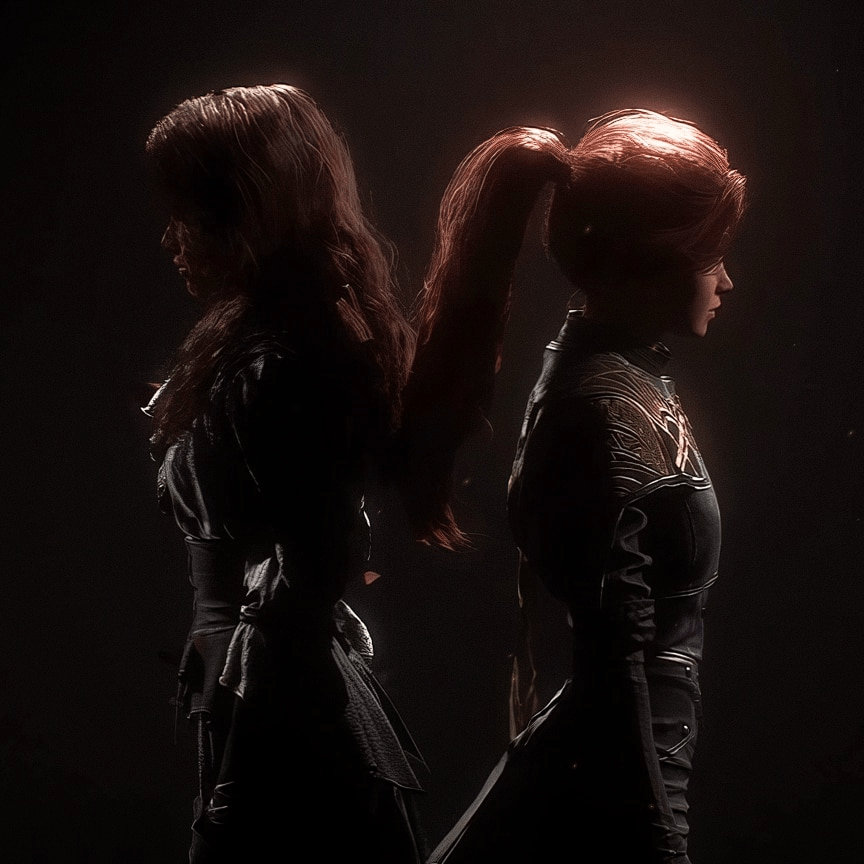
The boss, “Clair Obscur” in game. A very literal embodiment of the concept, symbolic of so many of the games themes – dark and light, in one person, split down the middle, held together by threads of light…
The premise
To recap the whole plot would be an exercise in madness – there’s a lot going on here. But to set the stage with an early recap…
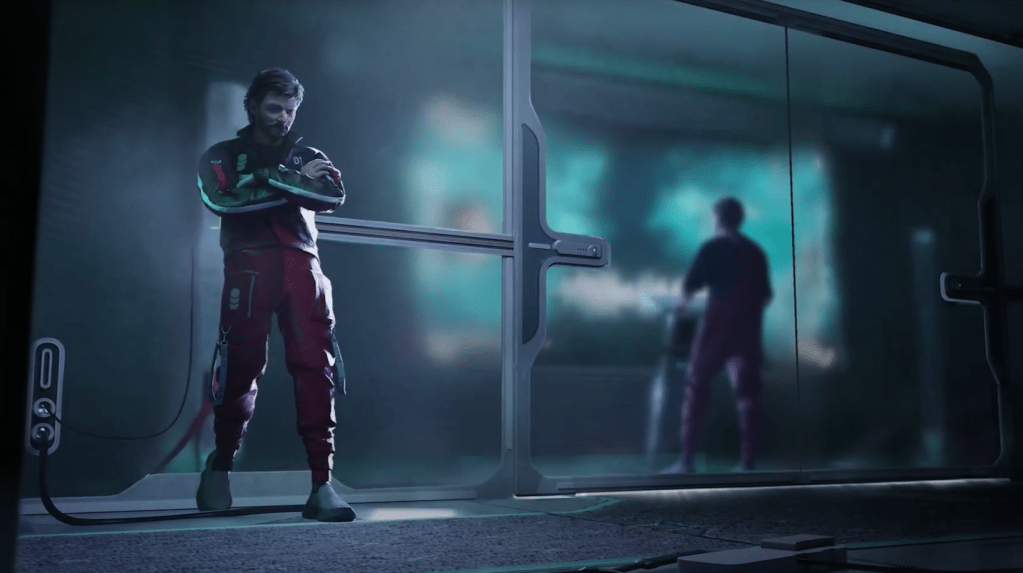
The opening 10-20 minutes set the world and the premise out beautifully. Our early protagonists, a 32 year old man (the age matters), and a teenage girl, Maelle, are standing atop a building in an otherworldly version of what looks like Paris. There’s even an impossible, bent Eiffel Tower in the distance.
Far across the ocean, a giant, obsidian monolith, with fragments of rocks suspended in the sky all pointing towards it, has the number, “34” painted across it in brilliant, white-gold.
We learn, through some extremely heart-wrenching storytelling, that each year, a giant figure under the monolith rises, erases that number, and paints a new number – one less than it was the year before. Today is that day, and as “34” is erased to become, “33”… a portion of the town’s population just… disappears. They fade to dust and a flurry of red and white petals, blown away by the wind.
It turns out, everyone that age and below when the number is painted, is claimed by the “gommage” – the French for, “erase”. Gustav’s love Sophie is one of the people claimed, as they stand in the harbour, surrounded by other vanishing souls – holding each other’s hands. “I’m here” Gustav says. “I know, I know…” Sophie replies through her tears… and then she’s gone.
Loss. Grief. This is just the start of a story that will come back to this theme time and again.
—
There’s a inevitability that everyone’s just accepted here in the city of Lumiere. Everyone, that is, except for the Expeditioners.
Each year, many of those with only one year left until their own gommage, depart on an expedition to journey across the ocean and try to stop The Paintress, the figure under the monolith painting death.
Or at least, that’s what we’re led to believe for the first 2 acts of this 3 act narrative.
The turn
As we follow Expedition 33’s exploits, we meet a man named Verso. Apparently, he’s around 100 years old – he came to the continent with Expedition 0, around 77 years earlier. And, it seems, he cannot die.
He becomes the party’s leader after Gustav meets an untimely end to a white haired man, around 50 or 60 to look at him, who wiped out almost all of Expedition 33 the moment they landed. More loss. More grief. Gustav was an adoptive father to Maelle, and as she puts it, “the best father and brother I’ve ever had”.
Well, it turns out the white haired man, Renoir, is Verso’s dad. And they’ve got a bit of a family spat going on. They cross swords (well, sword and cane), several times in Act 2.
Renoir & Verso
Verso leads Expedition 33 to successfully take down The Paintress. It’s done. It’s over. No more painting death. No more senseless loss of life back in Lumiere. Our heroes return, greeted by a warm, smiling crowd of people who have been given back their futures.
And then, from under the monolith, an explosion of red energy.
And everyone in the city is gommaged (by Renoir as himself – it turns out the version you’ve been fighting was painted by The Paintress) at once.
Everyone, that is, apart from Verso.
And Maelle.
An inner world with a twist
We wake up as Maelle, well, Alicia, sometime in the recent past. Well, recent past in the “real world”, that is.
It turns out that the world we’ve been inhabiting these last 20 hours of gameplay or so is, in fact, a canvas world painted by Verso. Or Verso’s real world counterpart. His family are, “Painters”, which in this universe appear to be people who can create these canvases that can contain whole worlds, that they can step into – and live among the inhabitants, who have their own lives, thoughts, feelings, beliefs… people who believe they are real, and in so many senses – are real, within this world.
Essentially, the canvas we’ve been inhabiting this whole time is Verso’s inner world. He even has representations of his childhood plush best friend, Esquie, who in the canvas is a lovably slow and silly demi-god, and his dog Monoco, painted as a gestral (a race of child-like paintbrush creatures).
In many ways, Verso’s canvas resembles a rich, detailed, vibrant inner world of someone who sees wonder everywhere, with the real world of his life represented in fantastical new ways.
But there’s a big twist to this.
Real world Verso is dead. He died in a fire saving his sister Alicia.
And so, with this world created by Verso being all that remains of him, his mother, Aline, entered the world and created ‘perfect recreations’ of her family, including Verso, within the canvas.
She loses herself in the canvas, refusing to face the grief of losing her son, and escaping into fantasy. Renoir, her husband, enters the canvas to try and persuade her to come back to the real world, and be with the rest of her family, who both need her and love her. But she refuses. So Renoir starts trying to erase the canvas from within. So Aline traps Renoir beneath the monolith. Renoir traps her at its peak.
The Paintress, Aline, at the peak of the monolith
A war to erase, staved off by Aline as The Paintress, saving as many people as she can each year, painting the number on the monolith as a warning to all those who will be beyond her power to save, begins. That was 77 in canvas years ago. That was The Fracture.
Alicia’s Alter: The story of Maelle
Alicia is burned, scarred, and has lost her ability to speak in the real world. She enters the canvas to try and help her father Renoir bring back her mother Aline, but the plan goes wonky and she is born into the canvas as one of Aline’s creations, to parents who soon die due to the gommage.
Named Maelle by her parents, in this world, Alicia has no scars, no burns, still has her voice. Until the end of Act 2, she has no explicit memories of being Alicia at all. She has, in effect, complete dissociative amnesia for her trauma.
Maelle, rediscovering how to paint inside Verso’s Canvas
But Maelle never really feels like she fits in with the others in Lumiere, either – unaware that she is, in many ways, the alter of a person who has experienced extreme loss.
But, once she reaches the continent with Expedition 33, she starts having visions. Nightmares. She starts recalling glimpses and screams from the fire. She gets somatic flashbacks to being on fire.
These kinds of somatic experience are really common in DID. Like, really common. It can feel like parts of your body disappear, only to experience extreme pain when a part that holds pain from the past comes back into awareness, perhaps only to be shut back out when that pain quickly floods or overwhelms the system.
“It is as if my body, or part of it, has disappeared”.
“I cannot speak (or only with great effort), or can only whisper”
“I am paralysed for a while”
“My body, or a part of it, is insensitive to pain”
It’s often not these symptoms that bring people into specialist dissociation services, but instead what happens when dissociation becomes patchier, when parts carrying a lot of pain come back into awareness when the dissociation is no longer, “needed”, so the part can process – but cannot process fully because the person’s experience of themself is too fragmented a whole. These are the kinds of tangles that therapy with a dissociation savvy therapist can help a person to gently, slowly, compassionately untangle.
Maelle is in the middle of a war, with herself, with her family, with her anger at the worlds, both painted and real – in her eyes, she does not have, or want, to be able to process the pain of all the loss that the fire brought her as Alicia outside the canvas.
A drawing we did of the areas of intense pain and ‘missing’ parts of our body from the start of the year
This type of somatoform dissociation and sensory flashback are most common in something like DID, where dissociation is a part of life since a very young age. But it brings us onto something that gets to the heart of why Clair Obscur: Expedition 33 feels so relatable in terms of dissociation whether you have DID or no dissociative disorder of any kind…
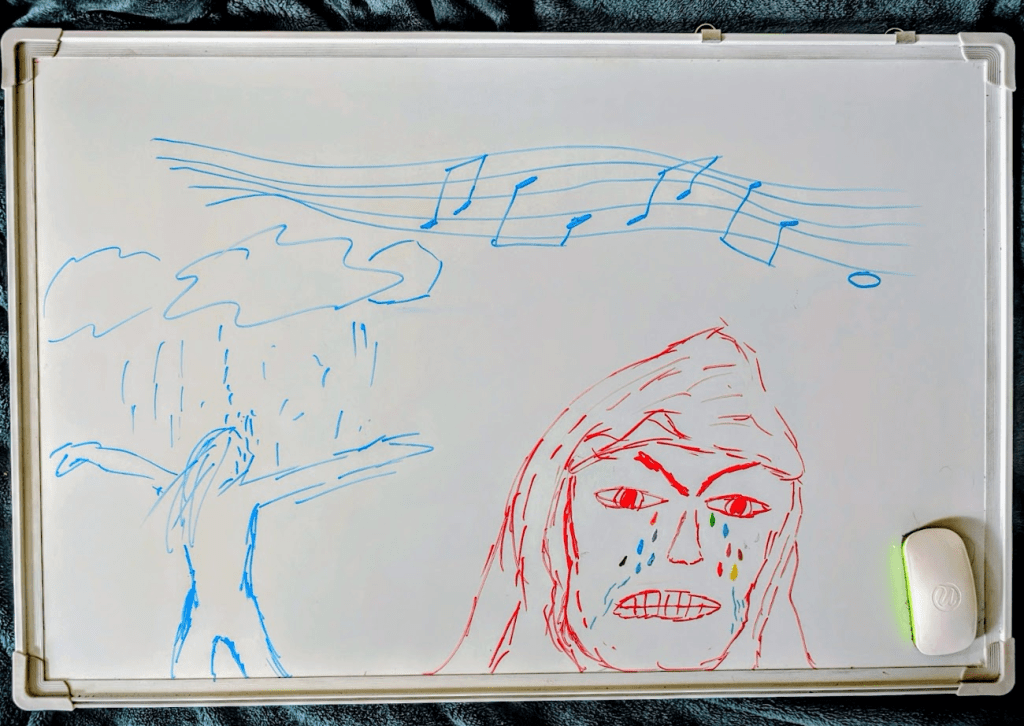
Art we drew when we felt like we’d lost our voice, like something was, “stuck”. This overwhelming feeling of anger, but behind it, feelings of fear and sadness that needed to escape, like we needed to be able to cry out, scream out – yet we had no voice. Hence art.
Clair Obscur’s Depiction of Depersonalization / Derealization
I think one of the reasons Clair Obscur resonated so deeply with me, beyond the raw emotional content of the story (and it’s an amazing, heart-wrenching story entirely in its own right), is the way it portrays dissociative aspects of grief.
Grief is often a huge emotion. It’s usually too big for most people to process in one go. “Everyone grieves in their own way; it’s a process” is something of a maxim to which there’s a lot of truth. It’s entirely normal for people, after the loss of someone very close, like a parent, child, partner, etc, to experience some symptoms of dissociation as they process the loss a little bit at a time.
Two things people experience after traumatic loss are, “depersonalisation” and “derealisation”.
Depersonalisation is, in essence, feeling that you, your body, and/or your feelings aren’t ‘real’ – that you aren’t real. You feel disconnected from yourself.
Derealisation is, in contrast, the feeling that the world around you isn’t real. People, places, things, that should feel familiar, feel strange, alien, otherworldly… ‘wrong’ (like The Truman Show). You feel disconnected from the world.
While Depersonalisation and Derealisation (DP/DR) are normal for everyone to experience at some point(s) in a person’s life – they can become a long term problem, and are also usually ‘baked into’ the everyday experience of more complex forms of dissociation like DID & OSDD. So, I’ll give a couple of quick examples from my own experience (so these are a bit more DID flavoured):
With depersonalisation, I frequently find myself experiencing my feelings as though they are not mine – that they instead belong to one of my alters. Or I may become surprised when someone tries to get my attention in my environment, because I “forgot that I actually exist”, with a body that other people can perceive, rather than being a dream of a person. A lot of my childhood memories I can recall as still images, with very little emotion – even the things that Sucked. I often feel like my alters / parts are more real than “I” am.
Depersonalisation in system terms
I’ll contextualise that in terms of the story shortly, but derealisation is a more straightforward comparison here:
Sometimes, when one of my little alters is out front in a non-negotiated way (usually due to a trigger), the world often seems huge. Like, if they’re out in public, people can feel three times taller than me, the buildings around me can look like they’re miles away, rooms feel expansive and enormous.
While we’re experiencing derealisation, the geography & architecture of the world can look impossible, almost non-Euclidean in nature. The world can seem to be so brightly coloured & contrasting it hurts our eyes, or almost monochrome (depending on which alter is out). My environment, and other people in it, don’t feel real.
Yet when adult parts become present again, things can ‘snap back’ to where I’d normally expect them to be. This happens often enough, that after a while this just began to feel like a normal part of our life.
Well, perhaps you can see the relevance of all this to Clair Obscur… In the game, you are constantly surrounded by the impossible, “familiar but strange” landscapes. Lumiere is almost immediately recognisable as Paris, from the architecture, clothing, the presence of the Eiffel Tower. Yet the Eiffel Tower is warped and bent in structurally impossible ways. The city itself is, in places, bent, broken, fractured.
The uncanny, fractured, fragmented landscape of Lumiere
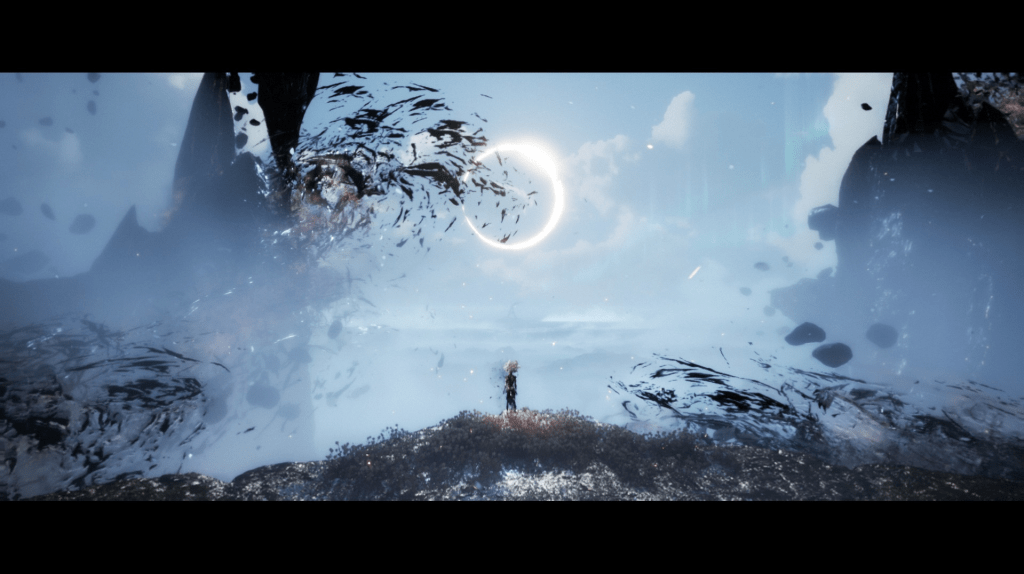
As you look over the sea to the monolith, the number painted on it, the halo of light that surrounds it – the white-gold is so brilliant as to sear itself into your eyes. And yet the whole scene is virtually monochrome.
As you explore the world, Verso’s canvas is filled with brightly coloured impossibilities – upside-down manors, bits of geography taken from one place and transposed into somewhere alien… One of the first places you visit is, “Flying Waters”. It’s like you’re under the sea, surrounded by fish, bubbles, it looks like you’re in a brilliantly colourful seascape. And yet, you can breathe, move freely – everything around you isn’t underwater; it’s flying.
The beautiful and otherworldly Flying Waters
Immersed in this world, you lose the expectation that things will, “snap back” to usual. The bizarre becomes normal.
Nous peindrons le Clair Obscur (we will paint the Clair Obscur).
This is what derealisation can feel like.
Depersonalisation on the other hand… well…
Wait… didn’t we die already?
… is what I found written in our journal one day. Maybe more than once, actually.
It’s not entirely uncommon, I gather, for some DID systems to have at least one part that believes they are dead, or that they don’t have a body. This part being close to the front & to awareness is very much a depersonalised & depersonalising experience.
In Clair Obscur – in Verso’s case – he doesn’t have a body, out in the world. He did already die. Painted Verso is referred to as, “All that’s left of Verso’s soul”. And he is acutely aware of this, from the moment you meet him. He knows that he is dead in the real world, and that he is being forced to live out this ‘fake’ existence – an existence he does not want.
This plays out in the games ending, and the choice that you must make in the final moments of gameplay – more on that shortly.
But as you may be able to imagine – I have a lot of empathy for painted Verso.
In contrast (there’s the theme of clair obscur, light & dark, again…) Maelle, in the canvas, feels most “her” when she is occupying this painted, inner world version of herself. She doesn’t identify with the bodily and emotional pain that she experiences out in the ‘real world’ as Alicia. By Act 3, she knows she still has a body, but it’s a body she doesn’t want to know, and will fight like hell to stay out of.
She is Maelle – a teenage girl, who didn’t almost die in a fire, who has her voice, her unscarred face, her older brother still alive. She experiences the painted, “inner world” as more real, and certainly more desirable than the world outside.
Maelle wants to live in this canvas, and remain separated from her still living and breathing body. Verso, to join his body in death, and to find rest, to find peace at last.
Dissociation is part(s) of ourselves protecting us from the things we believe are so awful that we wouldn’t be able to cope with them. Sometimes, what is so awful to us, is just.. ourselvesas we are… the world as it is… all of it.
That’s the impact of trauma & the beliefs that can embed themselves as an aspect of it.
Maelle’s experience is what DID in the present day can be like for so many people – and one of the reasons why a conversation that comes up for me in therapy from time to time is, “It’s important to visit the inner world, to be connected with it – but not to live there exclusively full time.”
I literally struggle with this exact dynamic that Maelle / Alicia is struggling with on a daily basis.
Back in the game, at times, we see Maelle being curious about Alicia when she meets herself as her mother paints her in the canvas (masked, virtually voiceless), and eventually developing empathy for her – but she wants to release her from her pain, and to go on living as Maelle here in the canvas.
She believes herself to be more real than the girl who is up there, out there in the ‘real world’ somewhere, with no voice, a scarred face, and all the feelings of a lost future that go with her unprocessed grief.
(incidentally, I’ve also found notes in our journals about having no face, or being unable to speak – again, very depersonalised experiences).
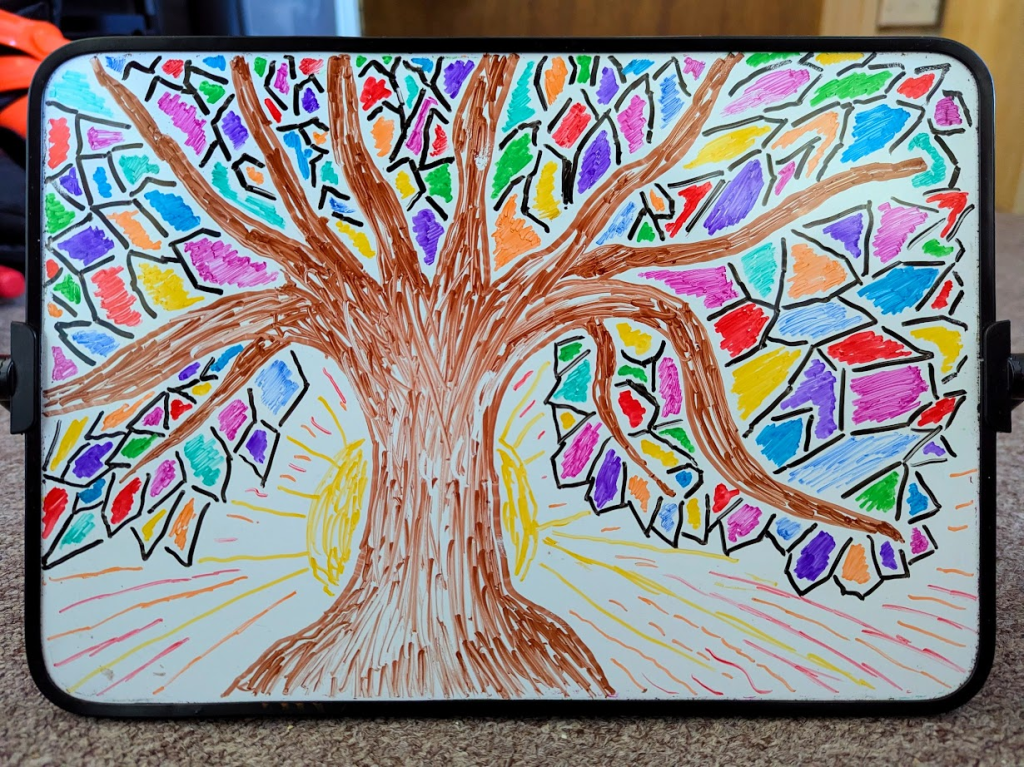
Art we drew earlier this year. Our body is 41 years old, and my parts are fighting like hell for us in what feels like an urgent race to beat impending doom. At times though, I feel like I’ve given up. Like my number has already been painted, and my parts just don’t know it yet. But, I am my parts, and if they’ve still got fight in them, then so do I – even the part that thinks we already died. We’re doing our best.
The Choice
The ending to this game destroyed me.
Having been ride or die for Maelle, and her position, taken up against her father Renoir, that she should be allowed to continue living in this painted world, with her friends (who real Renoir absolutely acknowledges as people)… we come to a (sort of) surprising turnaround that stopped me in my tracks.
Verso does not want to go on living, and in undoing himself, would end this world.
And I wanted to give him that – in spite of everything it would mean.
He does not want to keep being painted back to life, over and over – he wants to end it all. He’s experienced 100 years of torment in this canvas, and he doesn’t want to go on.
I chose to side with Verso (but also went back afterwards to see Maelle’s ending, too. I think I chose right the first time…)
As Verso convinces his child self to stop painting, the world is unmade… the heart of the inner world stopped, and all the creations in it, one-by-one cease to be.
This ending was hard, because we’ve come to know and love these characters, and even though this allows Maelle and Aline to return to the real world to grieve with each other, and the rest of their family (father/husband Renoir, & sister/daughter Clea), it means the end of the lives of everyone else in this bizarre, shared ‘inner world’ that has been Verso’s Canvas.
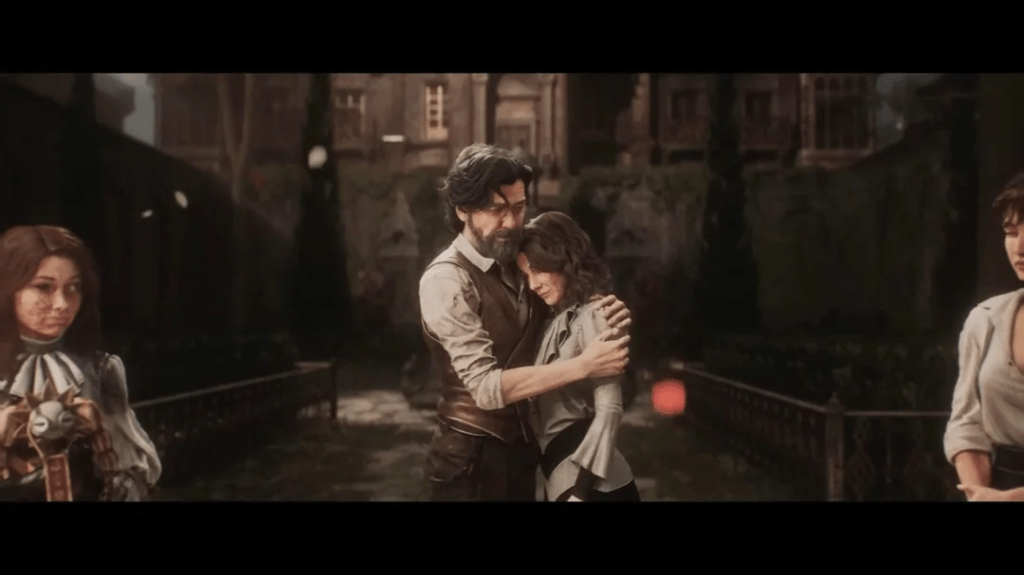
The Dessendre family – Alicia/Maelle, Renoir, Aline, and Clea, grieving at Verso’s grave in the world outside the canvas
This was also really hard for us, because there’s something about having, “people inside” that can change how you see life and death, and the prospect of ending your own suffering. Because you feel like you’re not just responsible for your life – it’s like you’re responsible for the lives of everyone else inside, too. Sure, we’re all parts of one person – but, at the same time, everyone in here is unique, and has their own memories, their own perspective, their own sense of, “I”.
Maybe I’ll be able to write more eloquently about this another time, but right now, it’s hard to think about.
It brings up so much for us, and sometimes you just need to listen to the, “Enough, for now” coming from inside.
Dans chaque colouer, une part de lui
There’s some great music in this game, and so I’ll end with some of the the lyrics to Une vie à t’aimer (A life of loving you):
Colours ablaze
Fire red, a life taken away
A painting I cannot see,
Closing my eyes, only black remains.
In black, his sad eyes,
Through gold, his laughter lingers –
In every colour, a part of him.
Ever loving him, even though he’s no longer here.
Painting love,
Painting life;
Crying in colour.
(Aline) On the canvas, our love’s enduring / (Renoir) On the canvas, our love’s ending
I love you.
—-
Until next time – take care of yourselves, kiddos.
I have, it’s safe to say, fallen deep, deep, down a rabbithole of looking for representation of DID experiences in media this last 1-2 years.
I wrote a post that covers a lot of good resources here.
But I’ve come across a few more things recently I thought might be worth calling out.
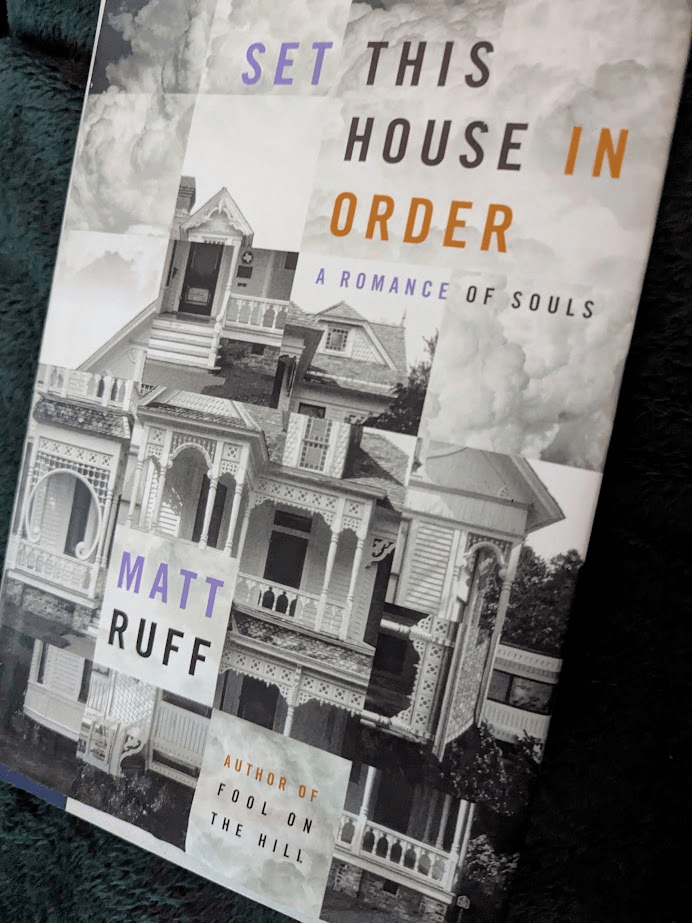
Set This House in Order: A Romance of Souls
A novel by Matt Ruff, who is not, himself, dissociative – this fictional story is actually a pretty neat & compassionate representation of dissociation.
There’s no kindle version (le gasp), so I ordered a copy second hand off Amazon – it said “good condition”, was half the price of new, and it came through pristine – so very happy at that. It was lovely to read a print book again, actually, rather than stare at a backlit screen – I highly recommend it if, like me, you’ve not read anything longer than a birthday card in print in the last [x] years.
—-
The setup
The story primarily follows two people with DID (it frequently uses “Multiple Personality Disorder” because it was written around the time that the language was shifting, but acknowledges DID as the up to date term in the text).
Andrew is the consistent front for the body of Andy Gage, the first protagonist. When we meet Andrew, he’s been alive for 6 months, after being, “called out of the lake” by his, “father”, Aaron (who was the host before Andrew). In Andrew & Aaron’s system, they use the term ‘soul’ for alter/part, and there’s a well maintained structure to how Andy Gage’s souls exist & conduct themselves.
This is all thanks to the ‘house inside’ that Aaron built – but found himself too tired to both run inside, and front for – hence Andrew being called out / emerging to take on the later role, with as little visceral memory of the trauma Andy Gage had been through as possible.
We start off following Andrew’s daily routine, daily life, in his role as the soul that drives the body, with the strict instruction from his father to only let others out at strictly planned times, or in an emergency – and that a big part of his role is to never lose time. And Andrew is proud of the fact that he never has.
That is, until he meets the other protagonist, Penny. Penny doesn’t know she has DID. But she knows that she blacks out, loses time, and wakes up to notes from ‘others’. And those others do not talk / write the way Penny does.
Andrew’s boss, Julie, who is also a friend with… boundary issues (which frequently confuses tf out of Andrew), asks him to try and help Penny to realise what’s going on with her. The fact Julie, a million miles from a trained professional in mental health, is able to just clock this – is maybe a little of a stretch, but there are some parts of the book it’s worth just rolling with.
The way things unfold from there, with Penny asking Andrew to help her build her own ‘house inside’ to be able to get a handle on her own dissociation, is at times a slow, thoughtful game of peek-a-boo between their various souls, turning into a cross-country escapade of losing time, with friendships and rivalries developing, inside and out.
While the level of chaos at times borders on comical, and there’s a certainty and distinctness to their switches 100% of the time (with none of the bluriness/blendiness that can happen for stretches of time) – it’s still relatable for us throughout.
—-
Personal reflections
I’ve done international travel with an ex that felt very similar to this, honestly – where we’d trigger a ‘shift’ (they don’t identify with the language of parts) in each other, and into dissociation, and it was hard to keep up with who was who moment to moment. Not something I want to dwell on – but I certainly think the author hits on something real with his writing, and it never feels like it’s poking fun at the characters.
As for Andrew & Penny’s various souls, I can certainly recognise some kindred spirts in my own system – Maledicta, Penny’s foul mouthed primary protector, reminds me of Jesse in a bad mood (“Like fucking hell you’re shutting me back inside until I’ve had a smoke, cocksucker…”), along with Adam, Andrew’s teenage part who is excellent at reading people, but gets scared whenever he has to actually interact with a girl.
Seferis, Andrew’s part that exercises to a routine to keep his body sharp and prepared to defend the family inside at moment’s notice, and comes forward with calm, honed, assured martial arts prowess when there’s signs of physical danger. Reminds me of Chance’s approach to the physical aspects of keeping us safe & well (while Jesse trains boxing & gets aggressive when we need it – they’re kind of an interesting partnership, in more ways than one).
Loins, Penny’s sexually mature, confident, seductive alter reminds me in some ways of Phoenix.
And Gideon, Andrew’s…. difficult… soul, who has been imprisoned for the last few years inside on the Island of Coventry (a name I love xD). Well, I’m just getting to know my own Gideon, I guess.
… and more besides. None of these are 1-1, of course. There are just relatable aspects. For one thing, my alters aren’t fictional. For another, they’re people with many different qualities, fears, strengths, personalities. But it’s fun to be able to, for example, read about the occupants of Andrew’s house inside, and feel a range of kinships from my own inner world.
There’s also some sex & gender stuff going on, and which is again, sensitively yet matter-of-factly handled. It actually strikes a really good tone for that stuff.
Because, yeah – Riley was born into a male body, with a different name; and now on feminizing HRT & with a passport that says female, and identifies as genderfluid. The way we experience life now includes an inner fam with masc, femme, non-binary, and genderfluid parts / alters. So at this point, the fact that, yeah, sometimes we’re a boy, sometimes a girl, sometimes neither, sometimes a blend, is not a big deal to us – it’s just how it is.
So the ways in which Andrew is, at a couple of points in the story, puzzled or frustrated by other people’s puzzlement about him in relation to gender (with some souls coming to the front calmly aware of why the person they’re talking to is puzzled or uncomfortable, but just don’t feel the need to explain themselves…)… wow is that familiar.
I won’t say more about the story in case you want to read it for yourself – but yeah, can happily recommend.
Trigger warning for betrayal, physical & sexual abuse trauma, and general representations of losing time & inner conflict between parts. It’s never gratuitous or particularly graphic at any point – but if those topics are difficult for you, just something to be aware of.
For us, the scariest thing was when one of the characters starts talking about final fusion – natch.
—-
Useful as a conversation starter
I recently used the book as a jumping off point for revisiting the topic of my own inner world with my therapist. ‘Building a house inside’ is one of the earliest things we did on my journey into all of this, with lil’ Harley being the first to have their own room inside.
One idea I liked in the book, was that Andrew’s house has, “the pulpit”, a sort of balcony where souls can observe what’s going on outside in the world, and easily communicate with whoever’s at the front in the body (usually Andrew).
As my ‘inner geography’ has become more of a forest grove, we’ve now got, “the treehouse”, which is a similar deal to the pulpit – it means I can look inside at who’s close to the front, and nip in and talk to them, without having to go, “all the way in”, and the overwhelm that can come with being in close contact with everyone inside at once.
As you can probably tell if you’ve read past posts of mine, I’m a big fan of being able to use media to communicate about these sometimes hard to grasp concepts. As the book tells a lot of the story from the internal perspectives of the main character – I think it might have something to offer people who struggle with this sort of, “inner world” building that can really help make sense of being, and living in harmony as, a family inside.
Alter
This short film is a wonderful <15 min slice of the DID experience.
This one is particularly easy to recommend because it deals with the everyday experiences that can be part of living with dissociation, without going near trauma as a topic.
It’s a slice of of life of a woman, already in therapy for DID, with a system who does lots of familiar things (journaling, play time for littles), who becomes aware of an alter she’s not yet met…
It’s also about the power of art to allow certain parts to communicate, and how art can allow you to experience your feelings more fully (they do some great work with shifting the frame / aspect ratio when different parts are present…).
It’s very light on dialogue, and more about going on an emotional journey with the main character through their daily life with DID.
There are a few lines that the main character utters out loud to those inside, that are daily staples for us, like:
*trying to do work* “Cummon guys, this is important, where’s my laptop…? … Yeah, I already tried there, thanks…”
*staring through the window for a gallery, then says to someone inside* “Ugh, fine!” *enters the gallery, realizes it’s showing her alter’s paintings*
I’ve parts that love doing art, and it’s a very good way of connecting and experiencing.
So yeah, Alter is brief, moving, and worth a watch.
Petals of a Rose
Another short film, available for free on YouTube, about DID.
In contrast to Alter, this one very much does show the connection between DID trauma.
So trigger warning for sexual trauma – I’ve linked to the version that was specifically edited to have everything graphic or surprising removed, but that’s the topic we’re dealing with here.
One thing it does have in common, is showing that slice of life, going round a grocery store, when a little spots a plush they really want, and the pleading of Rose (the protagonist) asking her to just leave it, promising they’ll play when they get home… (etc)
It turns out it’s a special night for Rose and her boyfriend, and she just wants everything to go smoothly, but she’s really worried that her system isn’t going to deal well with what she’s hoping will happen…
Well, the way her system reacts when difficult memories surface is a kinda familiar one.
I will say, the boyfriend’s reaction at the end of the film is one I’m still waiting for, I guess. The only person I’ve been vulnerable with around my DID while in an intimate relationship… didn’t react well.
I dream of finding someone willing to work together with me while we continue to figure all this out.
The scene at the end, where she’s thankful to each of her alters, is pretty moving & lovely, and what I try to foster among us whenever I’m strong enough.
So plenty here to recommend – albeit this one was much more ‘raw’ for me than Alter.
System Speak
This isn’t a recent one, actually, but I just wanted to shout out this podcast as one of the earliest things I found myself able to listen to, from a system opening up about their own experience of system stuff:
It’s also a great portrayal of certain aspects of dissociation, particularly Dissociative Identity Disorder (DID). The word, “dissociation” means “severance; division; disunion.” (from the latin dissociare – to sever or divide).
Dan Erikson, the show’s creator, has said the idea came from back when he worked a crappy job he didn’t enjoy, and spent his days wishing he could dissociate the day away – get in at 9am, and suddenly next thing you know, it’s 5pm and you’re leaving. Apparently, closely followed by, “That’s a scary thought – wishing to have less precious time on this earth.”
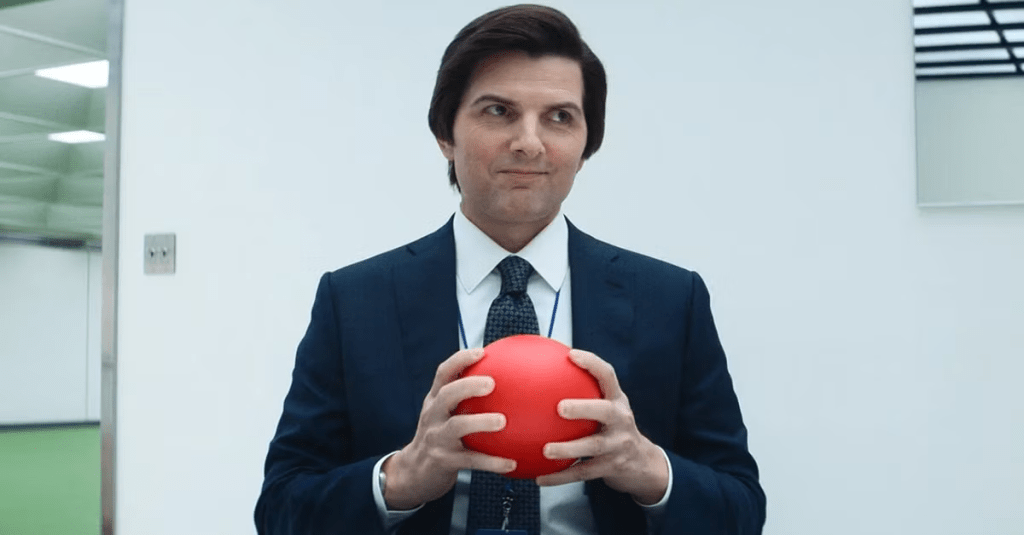
Severance is a show that takes that idea, and asks, “Well, if you’re not in the body right now… then who is?”…
… and then runs with it – spectacularly.
—
—
I was hooked on this show right from episode 1, after a friend recommended it to me as, “Heeey – so this show isn’t about DID per se… but you might find it interesting…”
Boy was he right.
So read on, if you’ve seen the show, and “real life severance” sounds interesting to you…
Obviously major spoilers ahead, up to and including the Season 2 finale.
What is Severance? A quick innie/outie refresher
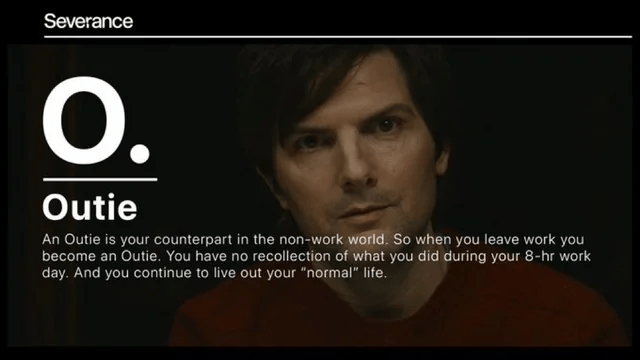
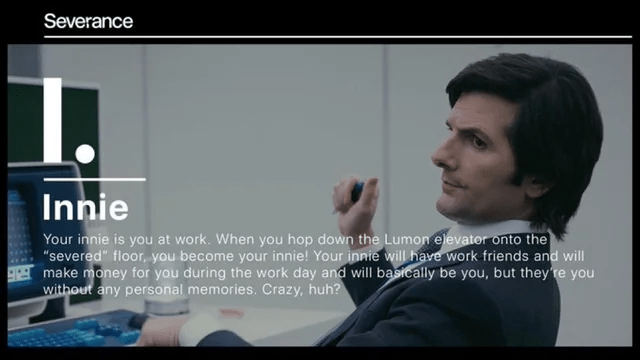
In Severance, “severed employees” have an ‘innie’ who goes to work, and an ‘outie’ who lives their life outside of work. It’s a process an unsevered person can choose to undertake – a small sci-fi chip implanted in the brain, that “spatially dictates” their memories.
In essence, the person making that decision remains the “outie”, and the ‘innie’ is created from the moment they wake up on the conference table on the Severed Floor of Lumon (if this turned out to be a nod to Fraser’s Dissociative Table Technique, that wouldn’t surprise me xD).
Outside of their job at Lumon, severed employees continue to have access to all their memories – except those created while on the Severed Floor. In the show’s term, these are the times their, “outie” is awake. Out in the world, it’s all the outie’s domain in terms of memory, identity, personality, driving the body.
—
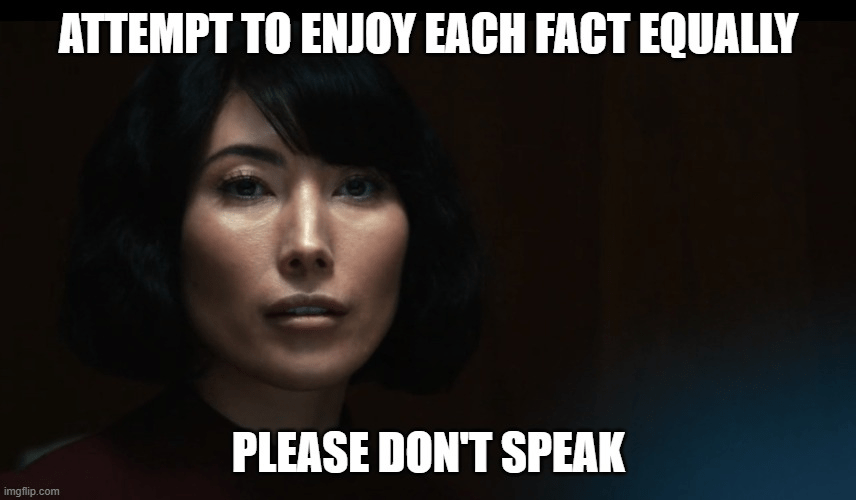
In contrast, upon successful severance, innies start their life largely limited to general knowledge, such as naming an American state, knowing that rain is water that comes from clouds in the sky, and the fact that there is a thing called, ‘the sky’ and it looks blue.
However, the intention seems to be that innies should not be able to access autobiographical or first person sensory memories, such as where they were born, what their mother looked like, how it feels to stand in the rain, or how that rain smells when it lightly kisses the grass in spring…
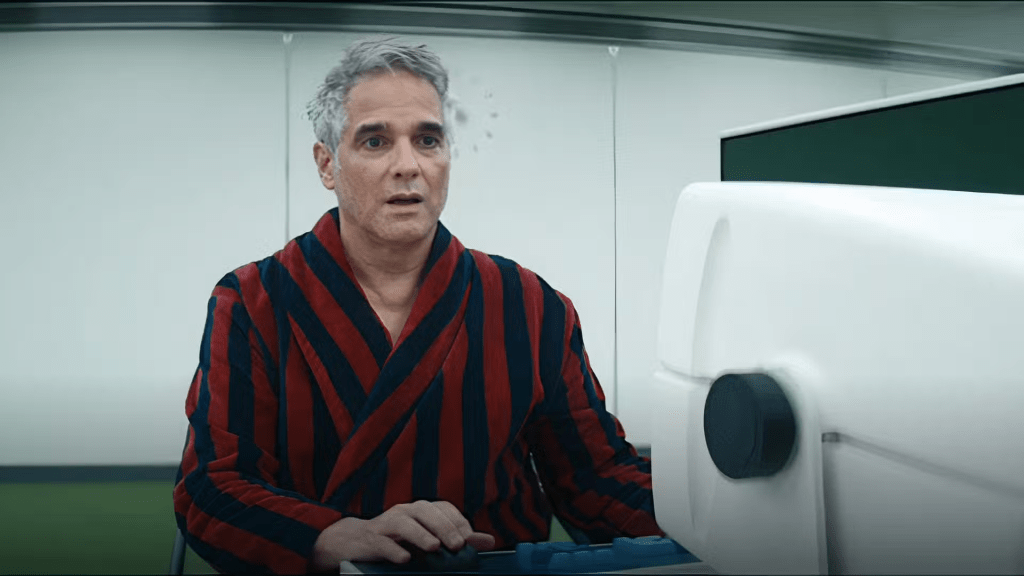
That’s how Helly R’s life as an innie starts in S1E1 – waking up on a conference table, understandably confused and being quizzed by Mark S over the intercom, accidentally kicking off…
“Who are you?”
That’s a big question for anyone, let alone someone who’s just been chipped & dipped… onto the office conference table, unconscious. Only to be roused by the world’s most nervous pub quiz announcer.
She doesn’t even know about The Ball Game yet.
I used to hate work ice breakers – they always asked for trivia about your life outside the office. Which my work-focused parts didn’t care – or remember – much about. They’d probably have loved The Ball Game, actually.
Poor Helly R – no wonder she gives everyone hell.
—
This results in two different ‘selves’ (in DID, often called ‘parts’ or ‘alters’). For example, the main character Mark, is Mark Scout outside of work, but while he’s at his job at Lumon, he is Mark S – and they alternate, laying down new memories that only they as an individual can access, and their other self cannot.
This is, in essence, a lot like what having parts or alters in DID can be like. Parts can often remember things that they were present for at the time, while being unable to recall times when they weren’t around – which can look like amnesia for important life events long past, or suddenly being surprised by where they are or what they’re wearing, unable to retrace their own steps mentally.
Real world innies & outies – dissociative parts in a nutshell
Broadly, dissociation can refer to many things – but in the Diagnostic and Statistical Manual for Mental Disorders 5, Text Revision (DSM V to her friends) there’s a section on different, “dissociative disorders” – including:
Depersonalisation (not feeling real, feeling like your body doesn’t belong to you…)
Derealization (feeling like the world around you isn’t real, or like it’s very far away, foggy, or ‘wrong’)
Dissociative Amnesia (not being able to remember everyday stuff and/or big important details about yourself or your past)
Dissociative Identity Disorder
That last one involves having two or more parts of your identity, that take the driver’s seat, and when they switch, the person can, ‘lose time’, and forget what happened.
Here’s the relevant DSM criteria, if you’re interested:
DSM V-TR criteria for DID
A. Disruption of identity characterized by two or more distinct personality states[…]. The disruption in identity involves marked discontinuity in sense of self and sense of agency, accompanied by related alterations in affect, behavior, consciousness, memory, perception, cognition, and/or sensory-motor functioning.
B. Recurrent gaps in the recall of everyday events, important personal information, and/or traumatic events that are inconsistent with ordinary forgetting.
There are three more, but C. is about whether A. and B. are distressing to the person, and D. and E. are basically about differential diagnosis (“not better explained by…”)
—-
Switching in real life
There’s a turn of phrase, and variations of it, that gets used a lot in DID, the idea of, “the front”. When a part / alter is, “out front” / “up front” / “at the front”, it refers to part that is currently, “driving” the body and making decisions. This does not necessarily have anything to do with masking or pretending in a, “bullshit – you frontin’!” kind of way.
It’s simply the part of the person that is currently in executive control.
When a part is not, “at the front”, we often will say they, “go back inside”. Some front a lot, for a long time, sometimes they swap in and out pretty freely throughout the day. Some parts rarely, if ever, front, and are always, “inside”.
It’s often a bit more complicated than a straight up “either / or” situation. Parts can “influence” from inside, or can be co-conscious (co-con), and / or blendy – but sometimes it is like, “one part is out front” then there’s a “switch” (another common term), and a different part is out front (a new duck).
The person may or may not be aware during the switch – sometimes this is where the experience of, “losing time” and amnesia come from, but it’s also possible to be aware of the switch happening and feeling like a passenger during some of, or even the whole, process.
When parts are at the front, or close to it, their memories tend to be fairly easily accessible. When parts are “deeper inside”, their memories may not be accessible at all, unless they’ve chosen to share them. They can also be patchy, foggy, emotions without narrative, or narrative without emotion, like they happened to someone else… but yeah, they can also be straight up unavailable.
Some people with DID have an, “inner world” that includes a system for accessing the front. For us, we have, “The Treehouse” which is kind of a co-con space near the front, and the part(s) at the front go out onto the balcony or roof of The Treehouse (The Deck), where’s there’s a column of light leading to the body (but they can always easily check in with The Treehouse to chat / check-in, without going “all the way inside”, which can be a lot).
Think of it a little like the elevator to the Severed Floor…
♫Switched from 9 til 5, what a way to make a livin’… ♫
DID starts in early life, to help that small child survive in the face of repeated overwhelming experiences (although parts can continue to emerge at any age). Severance is a sci-fi procedure that lets people do something similar – but starting much later in life. Being a system isn’t all bad, in fact it can be pretty cool – it’s the trauma that’s the bitch.
But why would someone choose this sci-fi version of DID as an adult?
Well, the outies in Severance have their various reasons for taking the job. For Mark – its about escaping the pain of the losing his wife.
As we learn, he tried to keep teaching and according to his sister Devon, it was, “a disaster”. Unable to cope with the grief, he started drinking heavily, and couldn’t hold down his old teaching job, too haunted by the memories of his wife and the overwhelming loss he felt.
Similarly, in DID, some parts/alters keep trauma away from other parts (often those most involved in going to work, staying housed and fed, hanging out with friends, etc), so that the person can get on with life without being overwhelmed.
And, in both cases – what can sometimes work well as an ingenious solution to unbearable suffering (Mark Scout, “It’s helping me”), can also lead to a lot of… unconventional experiences in day to day life. Not to mention it’s really hard to explain at dinner parties… if you could even remember… (“I’m just not grasping the visceral element of it…“)
So what is the “visceral element” of dissociation like?
“WTF were you doing with the body while I was inside?!”
Ahem. That’s totally not something one of us said today. No siree.
Early in season 1, most of the severed employees we meet have this chip-induced compartmentalisation, and these ‘amnestic barriers’ (‘time loss’ / blackouts / amnesia when ‘the other one’ is up front), very much in tact.
This is, in one sense, similar to the experience of having DID before you knew about DID, parts, and quite possibly, before you were aware of even having trauma in the first place – amnesia covers many tracks – essentially: “I can’t remember what I can’t remember…”
Except – both innie and outie are pretty clear on the deal – so it’s more like knowing you dissociate, but making no attempt to get to know your parts better, and no attempt at integrating what has been severed.
The ‘dissociative structure of the identity / personality’ is still very much ‘in tact’, to use a clinical turn of phrase.
—-
I loved when Helly R first ‘goes home for the weekend’ Friday evening… only to enter the elevator, and ‘switch’, opening her eyes a moment later and seeing… the elevator, arriving back on the Severed Floor… at 9am on Monday.
Mark S explains to Helly R that, yeah – they don’t experience going home, weekend time off, or going to bed… but that she may notice the benefits of sleep and relaxation now – “you may feel rejuvenated or happy… less tense in the shoulders… spry…”
Lingering, subtle sensations and emotions that feel alien to the person experiencing them, and like they come out of nowhere, are sometimes called ’emotional echos’. Emotional echos are left by parts that have been present, after they switch away from the front. These can be confusing, but you can also learn to identify echos and the feelings that tend to be a signature of specific parts after they’ve been around.
The reverse of this can be true too – a switch can come with a sudden and all encompassing change in feelings.
—-
You see this flip-side for Mark sometimes in S1 in particular.
In the first episode he comes into the office after sitting in his car crying his eyes out, followed by a slow, hunched shuffle into the building… But after he goes down that elevator, there’s that “bing!” as he switches to Mark S… and his posture immediately changes. He strides unbothered through those white corridors, and finding a tear-stained tissue in his pocket, and looks at it with a moment of, “huh, what’s on this?”, shrugs, and tosses it into the bin without a care.
Dissociation and the body can get real problematic over longer periods of time – and it seems to have a lot to do with emotions. Dissociated parts holding big emotions, whose cries go unheard over and over, still play out in bodily sensations, just without the affective element that fuels emotional processing.
If this is happening all the time, the brain will just, “Disconnect this device” to stop the constant Windows connection sound distracting you constantly. Which results in patterns of feeling like parts of your body “aren’t there”, while others are in searing pain from compensating these AWOL parts.
So yeah, being able to make narrative sense of what’s happening with these otherwise seemingly random sensations is important – as Mark is doing in his explanation to Helly.
One of our littles drew what was happening in our body earlier this year. Tension & absence. Frantic & frozen. And yes… yes it hurts.
—-
One last thing I’ll say; the scenes where Helly R / Helena Egan switch in the middle of something violent happening to them hit us real hard. The suicide attempt in the elevator in S1, when Helly R hangs herself, so that Helena Egan switches in as it’s happening… *shudders*
We’ve never tried, seriously, to commit suicide. But I have come back to awareness in the middle of self-harm, including being smothered & completely denied air for some time… and so… I know what it’s like to have a part trying to get your attention that way. It’s scary. But I know why they were doing it. I try not to ignore that shit, and find a common ground & go from there – unlike dear old Helena Egan.
—-
The compartmentalised systems of Lumon Industries
As a brief aside – it’s interesting that Lumon’s Severed Floor itself has real dissociative system vibes to it.
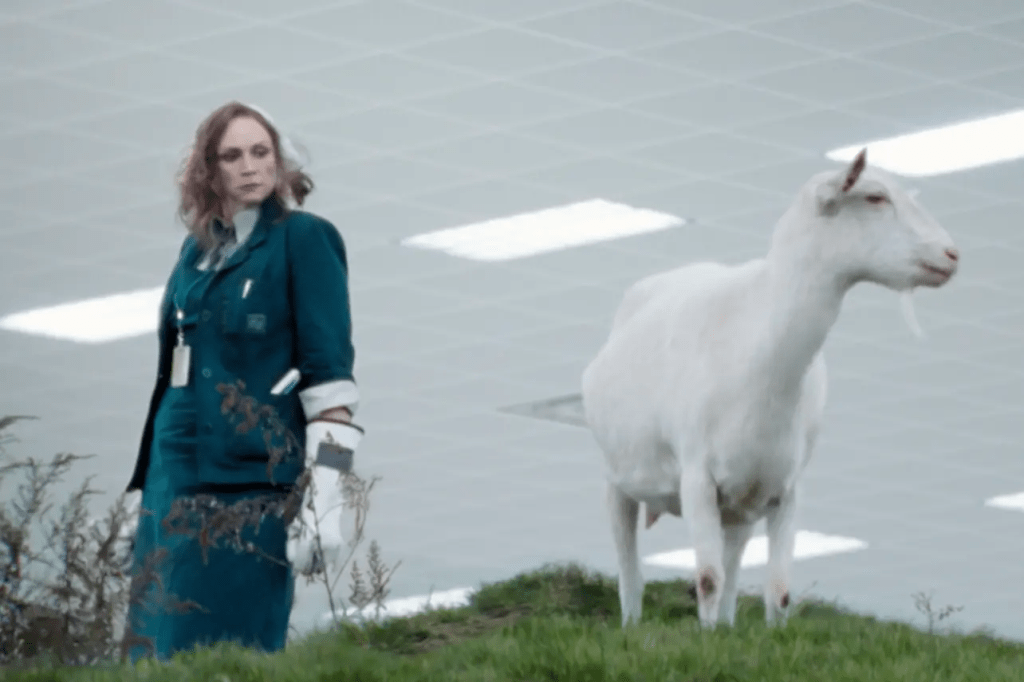
The “staggered starting and leaving times” (so “there’s less chance of us meeting each other on the outside”) that Mark explains to Helly alongside the sleep stuff is one of many examples of that familiar ‘dissociative compartmentalisation’ that comes up time and again in the first season. Another is the way all the departments are kept separate from one another, even on the Severed Floor itself – leading to such mysteries as, “what the fuck is with those goats?!“.
We stan Gwendolin Cristie, and her love for those delightful goats.
System Communication – the Season 2 finale
There’s one episode in particular in all of the show that spoke to me more than any other – the Season 2 finale.
The first 20 minutes or so of the episode focus on an ingenious solution to Mark Scout & Mark S’s inability to communicate (thanks to the Lumon “no unapproved messages in or out” policy). The birthing cabin that the senator’s wife uses to stay free of the experience and memories of childbirth – thanks to being severed, for that very reason…
Well, turns out, while inside, whatever activates the switch in Mark’s chip at Lumon does the same here.
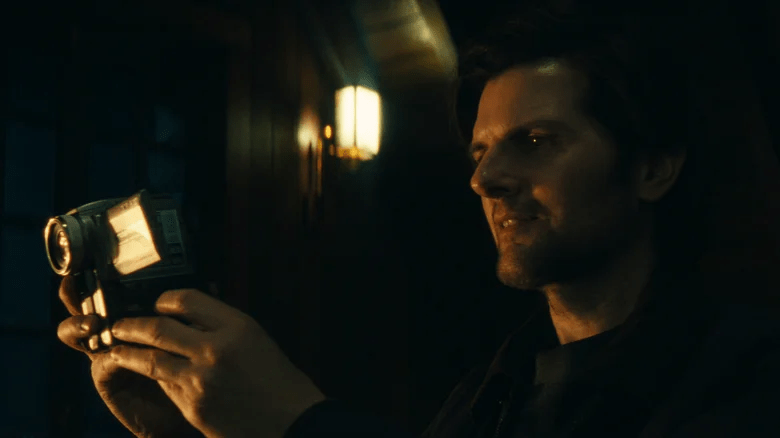
In other words, while in the cabin, Mark is Mark S, and as soon as he steps outside, he’s Mark Scout again. Devon & Ms Cobel hand Mark the means to, after 2 seasons, have a conversation with one another – a handheld video camcorder.
Mark Scout learning about system communication for the first time. Don’t worry, Mark – it gets easier, if you keep showing up for your selves
Mark S records a message inside the cabin, steps outside, *switch*, and Mark Scout is still holding the camcorder, records one right back, etc.
I love this scene. Not only is it a huge moment story-wise, but also; recording videos for one another between switches is one of the ways of communicating that we use. I tend to use it when I want to talk to a part that isn’t ‘here’ in co-consciousness right now (and doesn’t need to be). Or if I want to leave someone a reminder that I care about & appreciate them, they can watch if they find themselves out front without me.
In contrast; talking out loud to parts ‘live’ and au natural (i.e. “just talking to yourself”, perhaps in the mirror, for example) has a few limitations in our experience. Not least because it can get confusing as hell, talking and listening for internal reactions at the same time.
As for rapid switching to let dialogue for both parts play out, out loud… ooof. I don’t recommend it – the Default Mode Network, and therefore, the Inner Critic, tend to slip into these conversations really easily, characterised by wrote messages absorbed from childhood, (“Try harder”, “You always mess things up”, “Why can’t you just be normal?”)… and then everyone ends up having a bad day.
You can also quickly lose track of who’s talking and who’s listening, and more parts can become activated… just thinking about it is making me feel blendy.
So even if the parts you want to talk with are around, videos or voice recordings help slow things down & mean you can shift focus from who’s at the front right now, doing the talking, to the listening when another part is out front, and back again etc.
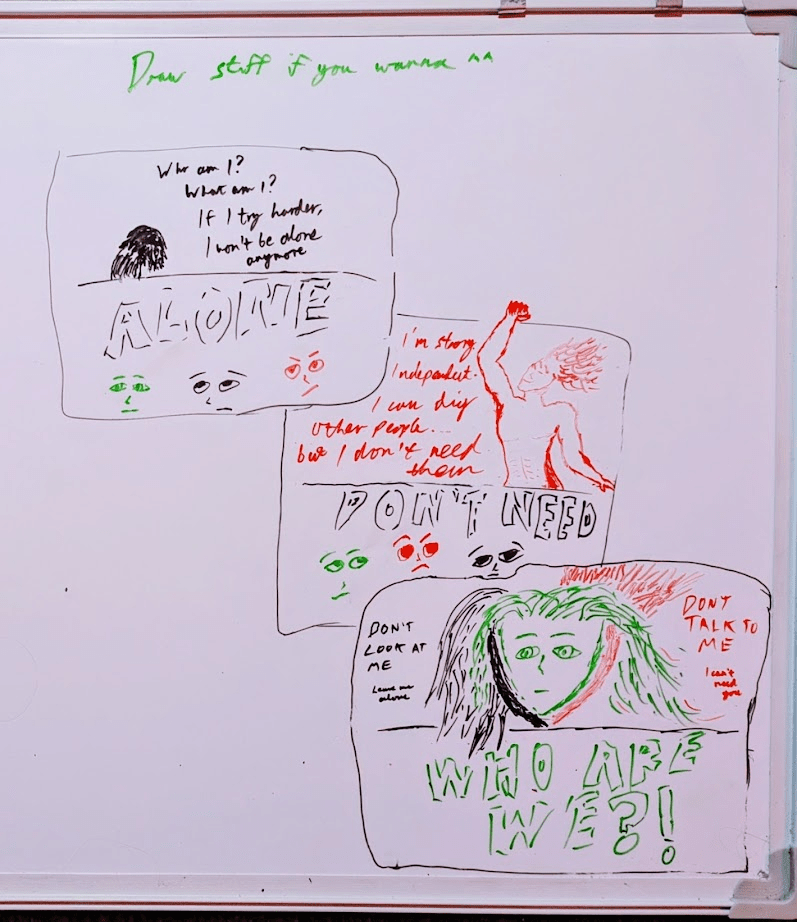
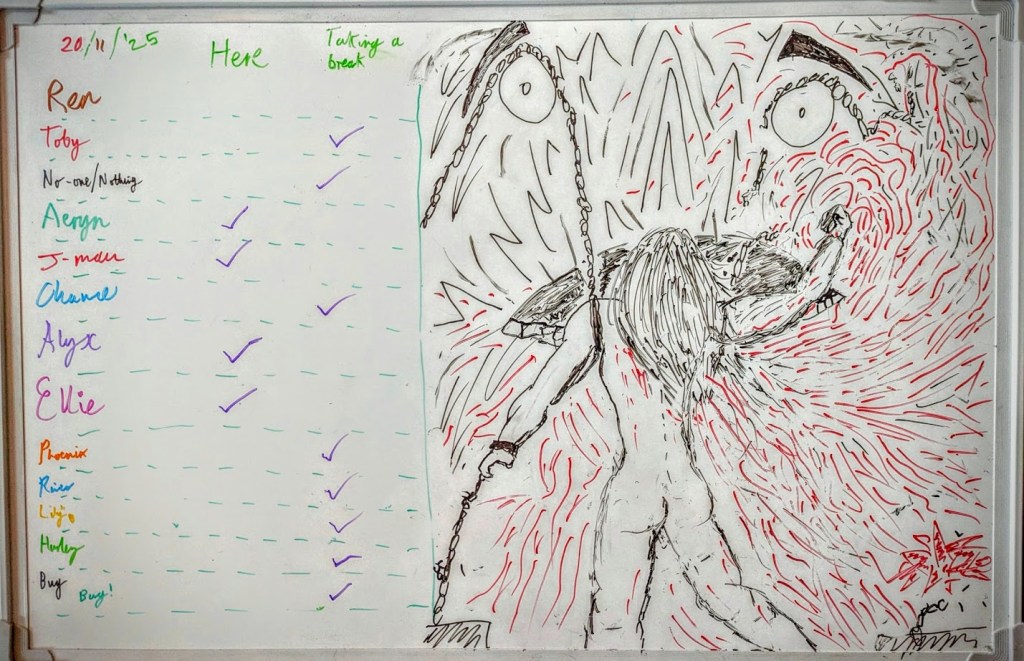
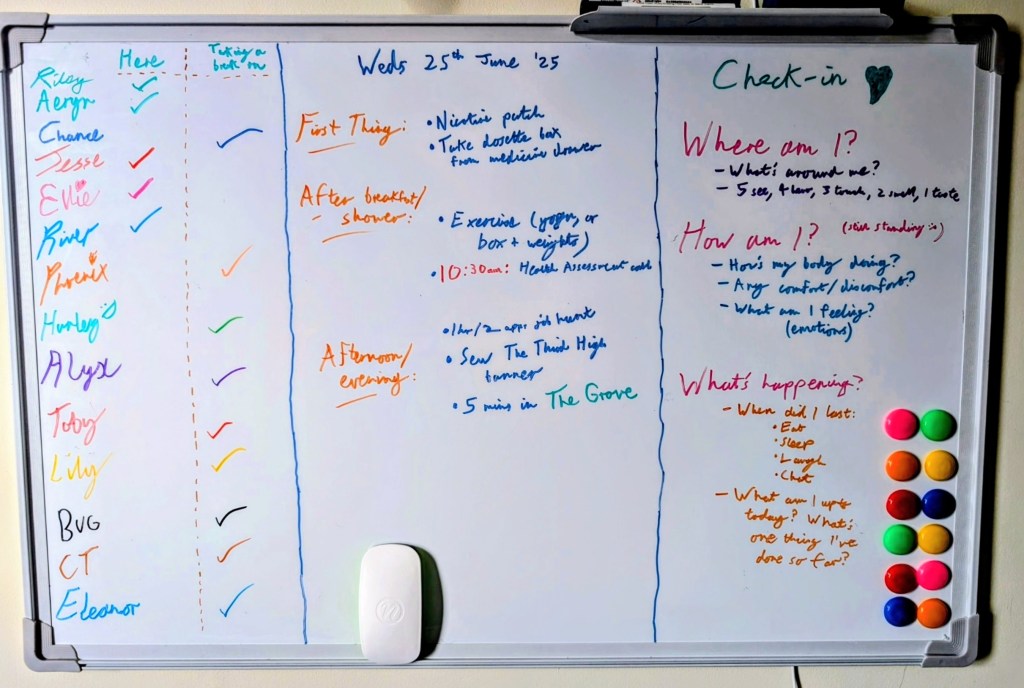
Asynchonous communication as with the Marks and the video camera, is a common technique for dissociative systems – one recommended in therapy by DID specialists the world over. Whiteboards, a journal for everyone to write in, post-it notes, voice messages, videos – anything that allows one part to leave a message while they’re around, for other parts to pick up later.
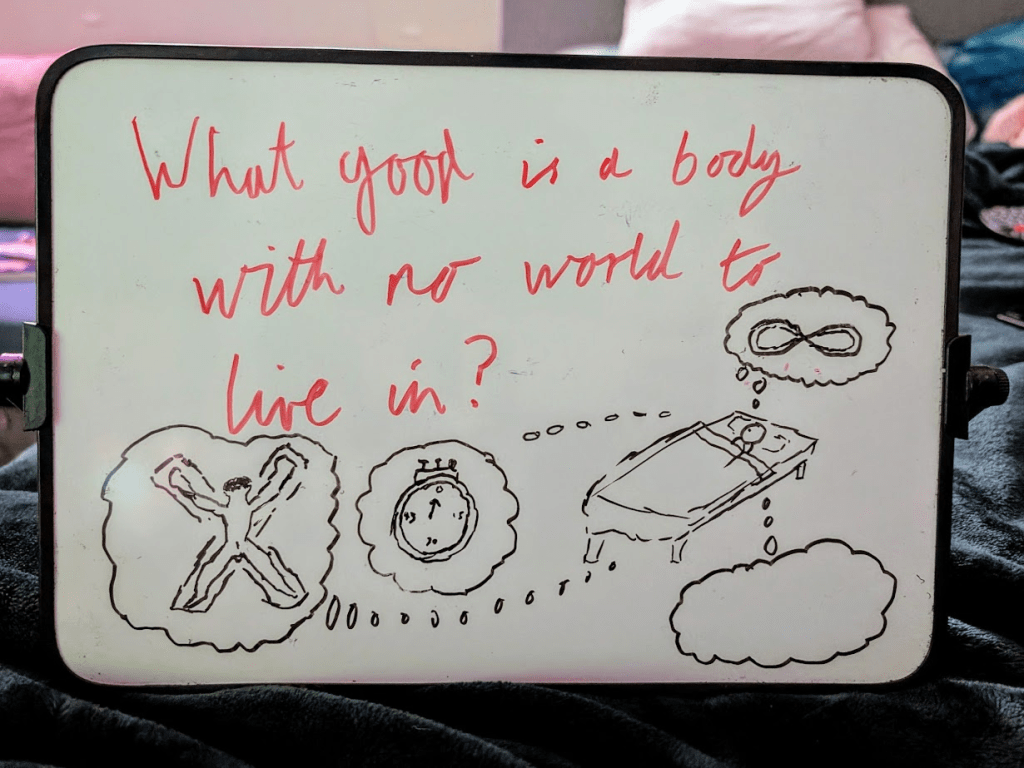
Whiteboard for roll call, and a space for parts to draw – a skill more available to some parts than words. This one was the third ‘panel’ in an evolving collaboration between Alyx & Jesse over the week. Both are great ways of improving ‘internal communication’ and a sense of connectedness between parts. Something Mark Scout & Mark S may benefit from if reintegration continues…
Now, these kinds of thing are built into our everyday life.
But go back 2 years, and the first time I did this, after realising that the me that went to work was, “So like a different person they don’t even seem to know I exist” – was in the form of writing.
That’s right – big, simple A4 signs in sharpie are how my ‘innie’ learned that my, ‘outie’ existed, is trans, and wanted to make some pretty significant life changes… a year before I even knew what DID was.
It took some time for a relationship to form and reach the point that our transition could move forward, that’s for sure – but when it did, it was a pretty huge moment in our life (turns out, not just because of the gender thing, when we realised there’s more than just 2 of us in here…)
Even when parts / alters do find ways to communicate, be they inside, or through various equivalents of answer phone messages – things don’t always go smoothly…
—
Can’t You… Just… Trust Me?
Of course, in the Severance Season 2 finale, things go anything but smoothly when the Marks talk to each other.
Mark Scout makes his request of Mark S – help me free my wife.
That’s it, that’s the whole thing. He hasn’t even thought about how the whole thing might sound to Mark S, or what his motivation to help might possibly be.
Well… Mark S immediately sees things from his own point of view, obviously – helping you with that would result in the shutdown of the Severed Floor – meaning I, and everyone I know & care about, would essentially never wake up again. So I’d “really be helping you out”… by dying for you. You’re asking us to die for you.
It doesn’t help Mark Scout can’t even remember the name of the most important person in the world to Mark S – who, correcting Scout’s “Heleny” flub, says:
“It’s Helly, actually… that’s the person I’m in love with… which you’d know if you’d ever taken interest in my life… before tonight when you needed something…“
Big. Oof.
Been there. Been there more than once, my dude.
When Mark Scout tries to mollify him with talk of reintegration, Mark S questions whether it’s even possible. Mark Scout starts to lose it and finally, frayed, exclaims, “We are in this together… can’t you just trust me?!”
The simple reply recording comes back swiftly.
“No.”
It’s hard to describe the feeling of seeing this – something we’ve lived for real – play out on screen. You want to know what DID is like for me (and, as far as I can gather, for so many)? This episode, more than any other, brings so much of it to life.
It’s not uncommon for parts that have been, “shut out” or “shut down” within a system to feel like this. They can feel unwanted or unappreciated. Often in DID, there are young parts, that may have wanted help for a long, long time – crying out with no reply.
Regardless of whether a child or adult part, they may not be open to requests from the host or other parts in the system until some level of familiarity & trust been established. The needs and wellbeing of that part have to be made a genuine priority in terms of actions, and taking notice when they’re in need – words are often not enough.
Parts also often worry that the person will try to “get rid of them” (as Mark S does) – often because, when first starting therapy, that’s what a lot of people with DID would really like to happen (as Mark Scout quite possibly does, who knows..)
Dr Mike Young, Director of the UK’s Centre for Trauma And Dissociation (CTAD) clinic, explaining that – yup; that conversation between the Marks is one many systems have had at some point
In my system, by the first time I spoke to Jesse, I’d been scared of meeting “whoever or whatever was over there in the shadows” for years.
And when I tried to say hi for the first time, I got a pretty clear, “Fuck you & clear off“. In fact, the first time I tried, “going inside” at all since transition, to able to get any sense of other parts… well, I lost three days…
It takes time, commitment, patience, compassion… it’s a lot like, y’know… relationships with people. Because that’s exactly what they are.
Funny, that… Helena Egan, I’m looking at you (S1 video message to Helly R – “I am a person, and you are not…“).
—
Mark S ends up going through with the plan to rescue Gemma – but he himself doesn’t follow once she’s out the fire escape, choosing instead to keep hold of the front as long as possible.
Sure, Lumon’s severed floor is… somewhat in uproar, but he isn’t ready to give up his existence, his life, or Helly, and wants to keep fighting for them here, where he has agency.
This is a bit like what happens when parts needs are repeatedly ignored. Eventually, they can, “take the wheel”, and start driving the body without your awareness or permission.
This happens to us from time to time, and these, “non-negotiated switches” or periods of refusing to pass the driver’s seat back, after their planned time up front has passed, is a big part of where having a dissociative system can go from being just another way of being, to causing difficulties in every day adult life.
The Severed Floor gives me similar vibes to this part art, Wonder if Mark S & Helly R will get to experience the world in S3?
Mark S never even agreed to the plan.
He either just doesn’t trust that Mark Scout on the outside will keep his word to find a solution, to reintegrate – or he doesn’t want to become a mish-mash of the two of them at all… he knows himself, and he kinda likes who he is… and honestly, all he knows about Mark Scout is that he seems self-absorbed.
Well, and that he can put up a tent in under 3 minutes, I guess (thanks, Ms Casey – I enjoyed that fact equally).
Honestly, I have parts that relate to Mark S.
After the video camera conversation, when Mark Scout yells: “He’s like a child! I even mentioned reintegration and he basically called the whole thing bullshit!“
Devon replies: “Well, I mean he’s not wrong, right?”
Because integration is a hot topic for us, as it is for many DID systems.
Final Fusion (Kier Mania Remix 2.0)
In therapy for DID, “integration” is usually one of the core goals. This doesn’t mean “getting rid of” parts. It means bringing them closer together – better able to communicate, share memories, be more co-ordinated about what we’re doing in life and in our day to day, and to be more co-ordinated in our body.
Severance’s portrayal of ‘reintegration’ so far indeed involves the walls between outie & innie memories breaking down. It hasn’t exactly worked out smoothly for Petey, or Mark Scout so far – so it’s hard to tell how the process is meant to go next (I’m assuming “Fall down dead in the snow looking for vending machine snacks” wasn’t one of Petey’s treatment goals).
This is what happens when you walk out of therapy mid-integration phase & don’t keep up your sensorimotor exercises, Petey
In particular, the question of how the person experiences the world now they’ve suddenly got access to the memories of two very distinct parts that, as Petey demonstrates, aren’t necessarily easy to integrate at the level of somatic experience (the body keeps the score…)
Also, do both those parts still experience themselves as separate “I”s? Can they each take control of the body & switch? Are innie & outie co-conscious with a new “host”?
Do they become one self, with no separate parts, no innie & outie? “Just me.”
In DID therapy, this last state is called ‘final fusion’ – the result of (often years) of integration through therapy & healing experiences as a system. As the ISSTD Guidelines on treating DID (the international gold standard), summarise:
“Integration is a broad, longitudinal process referring to all work on dissociated mental processes throughout treatment.
Fusion refers to a point in time when two or more alternate identities experience themselves as joining together with a complete loss of subjective separateness.
Final fusion refers to the point in time when the patient’s sense of self shifts from that of having multiple identities to that of being a unified self.”
‘Fusion’ is when two or more separate parts / alters / fragments ‘dissolve into’ one another. It can happen during integration by itself when unburdened parts find themselves becoming close to kindred parts. When all parts are combined, what’s left, in theory, is one person, one self – no parts’ memories, skills, or personality etc is ‘lost’ per se – they’re just all held within a single self.
It’s very common for systems to have strong opinions on whether or not final fusion is something they even want:
“A desirable treatment outcome is a workable form of integration or harmony among alternate identities […] Even after undergoing considerable treatment, a considerable number of DID patients will not be able to achieve final fusion and/or will not see fusion as desirable.”
(note to self & fam – pitch a parts-y video game and call it Final Fusion…)
I’ve done a whole lot of integration these last few years; experiences, parts, memories, feelings, that were either walled off or behind dense fog, coming closer together, more connected.
I’ve only experienced temporary fusions, though – including once or twice, after a period of intense activity inside, waking up to the sense of, “Wait, where’d everyone go? Is this re-traumatization?!” and after I’d explained what I was experiencing, my therapist saying, “That… sounds more like fusion…”.
“Ok, but… everyone?!”
I didn’t like it. And it didn’t last long. Apparently temporary fusions are not uncommon, kind of a, “trying it on for size” kind of thing – and there are all kinds of reasons it doesn’t stick.
—-
While not always quite so dramatic as Petey’s reintegration sickness (although, eehhhhhh…) – this is what DID can be like when your, “worlds collide”, when amnestic barriers start to lessen and parts start becoming more apparent to you.
Flashbacks can start to happen, or become more frequent, and this sense of overlapping identities, perceptions, conflicting sensations in body & narratives in mind… well, those can all start, or ramp up, too.
Starting therapy for complex trauma and dissociation often comes with warning from any halfway diligent therapist – “if we go ahead with this, things will get worse before they get better.” Unfortunately for Petey, he started the reintegration process, then ran out on his therapist while things were still much, much worse.
“Integration” is a process the human mind & nervous system is engaging in all the time. Memories, experiences, feelings, beliefs… as we experience, lay down new memories, and remember but from new perspectives – this is all part of being & becoming; the constant act of processing, deciding, doing, reflecting – it all comes together into the miracle that is you.
Structural dissociation (the term for real life Severance au natural) can make this process pretty squiffy – memory fragments, perceptual distortions (everything looks three times taller than it is, then *switch* … now everything’s ‘normal’…), identity confusion, body stuff (headaches, convulsions, stiffness, body parts having a ‘mind of their own’)… DID symptoms come from a lack of integration, and an ongoing lack of realization experiences (completion of thwarted actions and experiences).
Embarking on integrating & healing a dissociated system can turn your shit upside down, and then some.
But as much pain as there will be, if you can find your way to embracing what was once severed – it is worth it.
The way this dynamic’s evolved for us has been a wonderful thing, but it’s an ongoing series of conversations. New parts reveal themselves as their comfort with what’s happening in the system grows – often from seeing that parts who’ve already chosen to trust have been accepted, listened to, and have more of a say about what happens without having to “take the wheel alone” (which can be quite scary for them).
While you may be late to the party…
… your parts will have your back – if you show them that you’ve got theirs, too.
So yeah…
… from it’s core premise, to so many ways that it’s explored that premise over 2 seasons so far, Severance has a lot to offer when it comes to talking about dissociative parts in DID.
It’s also just a great, super well made and entertaining show.
Here’s hoping Season 3 will continue to be just as awesome.
In addition to finding out how the show handles what’s next for Mark Scout, Mark S, and integration… Do Mark S and Helly R have a future together, inside or outside Lumon? What will become of Dylan after going super-sayan on Mr Milchick’s ass? And…
… what the fuck unhinged bullshit will Harmony Cobel pull next?!
I know we’re looking forward to finding out 😉
Until next time – take care of yourselves, kiddos ❤
Trusting other people isn’t something that comes naturally to us. Well, to me, anyway.
Some of us are very easily trusting, I think – others less so. Because of our early life experiences, we remained many ducks in one nest, so our brain made a team.
Some of us wanted to be close to other people and would go towards them, connect and find joy with others – and still do today, like little Harley. Some of us learned to fear the people we depended on early, so we got strong, independent, learned to be defensive and to question people’s intentions, or at least how much we could rely on anyone else being there when it mattered. Jesse takes charge in a lot of those situations.
Life felt unsafe when we were younger, whether it was or not – and dissociation is how we adapted to cope. The problem with times when there’s a lot of dissociation going on today, is that we’re not always super co-ordinated about how to keep ourselves emotionally safe in the here & now.
In the here and now today, we’re in an adult body, with lots of social skills, and people who love us. We have a doctorate, a great career record in academia, the NHS, private sector, and now our own business – all this stuff that shows that we’re anything but helpless. We’re not dependent on any one person, and we’re capable of having close, loving relationships with friends and others that last decades.
But – when things rock the boat, some of those old vulnerabilities can get triggered. Some of the young ‘uns inside, in particular, can start to come out and act from a place of trying to meet needs that weren’t met a long, long time ago – in ways which left scars.
Sometimes things go sideways in close connections and things can get overwhelming if we’re already stressed. Sometimes we screw up bad, sometimes we don’t know how to express ourselves or how to manage our emotional safety effectively.
Sometimes we’re just in a connection that is not healthy for us, and we have to grieve relationships we didn’t want to end. Either way, it’s interpersonal connection that’s at the heart of the stuff that hits us hardest, the good and the bad. I think it’s probably the same for most people.
When those things happen, those old wounds can show up in what we do in the here & now. Swapping drivers. A new duck. That can often be accompanied by dissociation, losing time, amnesia, generally being disconnected from what’s going on.
Part of how we heal is by letting those parts come out and express themselves. Often in non-verbal ways – it can look like really big feelings that we just don’t know how to describe but just need to let come to the surface. Or… well, I don’t know what happens when I’m “not here”. But just being with another person, being held in their caring attention, being witnessed – these can all be hugely healing.
Choosing to let that happen though – to share with another person, when you know you’ve got a lot of big feelings that you’re trying to hold back in your daily life… it can feel like a big leap. When you’re really dysregulated & dissociating a lot, and know there’s a good chance that parts are going to come forward ‘without you’… Willingly ‘letting yourself be seen’ by another human being when life is hard – that requires a huge amount of trust in that person from the rest of us.
We don’t want to see the little ones get hurt again, rejected again, let down again. We don’t want Riley to suffer, and we feel like we’re doing our jobs badly when that happens.
That’s where a good therapist who understands trauma & dissociation is so invaluable. I sometimes think of ours as some kind of wizard. There are certain techniques, skills you can be taught, for working with trance states when you’re deeply dissociated – that can certainly feel that way. But those are like cheap parlour tricks compared to being able to openly and honestly share your thoughts and feelings with another person. I’m really glad that I found someone who I feel that way about – and in turn, I’m learning to trust & share with other people in my life, too.
It didn’t magically start out like that – it took a long time & a lot of work, on both our parts, to get there.
—
Therapy as a safe harbour for exploration
Now, though, we’re able to have frank conversations about things like dissociation in therapy. To give an example from this week – to be able to say, “I don’t remember much of what we’ve talked about in most of the 7 or 8 times we’ve met this year” and “Yeah, sometimes I wake up in the middle of a session & wonder how I got there, while trying to hide that that’s happened…” I know that it’s ok to share that stuff, because I’m talking to someone who, without missing a beat, responds, “That’s ok – sometimes we just need to make space for parts to be present & be witnessed”, and that, “just because a conversation was with a part, doesn’t mean that we weren’t also connecting in those moments – even if you don’t remember it.”
He’s right about that – and the whole thing kinda blows my mind still sometimes. But a little wonder is a good thing, as long as we don’t get too side-tracked by staring at it all the time.
Time & again he’s held me through big, big emotions, been patient and kind, set clear boundaries & been firm but understanding when some of us (*whistles* – J) have been testing them. He’s someone I can depend on, and importantly – he’s shown he knows what he’s doing through words and actions.
For a long time early on, I was grappling for the first time with all these questions like, “WTF is dissociation; I don’t get amnesia… do I?; Is it DID?; WTF is a system?; How do I know if I’m a part or a person…?.” (I say first time, because yes – I forget the answers & experiences of finding out, sometimes).
I would question his knowledge, or skill, suggest I needed to go find a psychiatrist elsewhere. He ran rings around me every time (I say “ran rings” – it wasn’t a contest, but it felt like a fight to some parts).
Trust was slowly built, every time he showed me patience when I’d come back to the same questions, the times he was calm when I was panicked – and times I shared things I’d never shared with another person, and was met with kindness, compassion, empathy.
—
Dissociating? We can still show up
I want to share a story from about 6 months in, when my therapist had convinced my analytic, cautious, psychologist-oriented, and boundary-testing parts that, yeah, this guy knew the theory, had a lot of skills & experience, and we didn’t need to keep questioning him. It was time to start really taking some leaps with getting present, being honest, and trusting that he wasn’t going to let me fall.
I’d met about 5 of us by then, but still didn’t feel like I really knew anything about this stuff, not really – I was still wrestling in a very intense way with the feeling that I was making everything up – the symptoms of complex trauma, the dissociation, having parts, all of it. While also frequently feeling almost disabled by all those things showing up in my daily life.
I was in a bad place. I was frequently getting overwhelmed from some really difficult shit in my daily life, which led to a lot of re-experiencing past trauma. I was a bit of a mess.
Something particularly bad had happened, I don’t remember what. We had a therapy session booked that evening. I wanted to cancel, but pushed myself to show up; “the times we’re struggling the most, are when we need other people the most”. That sentiment felt very, “… but that’s not for me” at the time – but I trusted my instinct that trying, at least, was the right thing to do – whether I felt like it or not.
We got to the end of the session, late in the evening, and I was in pieces – feeling like the fire inside was close to going out. He’d stayed with me, with my pain, through so much over the last hour – and he checked in with me as much as he could, made sure I had emergency hotline numbers and such, “What’s important right now is safety.”
I didn’t remember anything about the session, just signing off, wiping away the tears and collapsing into bed, exhausted & dejected. Done. Didn’t care if I saw another sunrise or not. I couldn’t take this anymore. I was done.
Then the strangest things started to happened. My (then) youngest, most hopeful and tender part came wandering out & wanted to play… seeking comfort & togetherness. Bringing joy in the face of all this hopelessness. We snuggled under blankies together, hugged our plushies, found some silly TV to watch. Even had a little sing & dance after a while. Over the next few hours, I remembered that that world was an alright place to be, actually.
Then at some point over the next couple of weeks, I started to get odd memories of moments during therapy coming back – particularly facial expressions I’d never seen my therapist make. Almost like… these playfully eye movements and a few silently mouthed words, like, “Go on! It’s ok!”
I wondered if I was just daydreaming – but they sure felt like memories – just not my memories. I couldn’t make head nor tail of it, I felt so disoriented – but I was more stable, more curious, more present overall – I’d give it time, see if it made sense with a day or two. It remained mysterious, but not scary – I just wanted to know what was going on.
There was enough trust by now that I knew I was talking to someone I could share my experiences with honestly, that I mentioned it during the next session. I didn’t know what to ask other than, “Any idea what’s up with that?”
“Oh…” he said…
“… that’s interesting. You remember that?”
Huh?
“Yeah, I guess, if you’re telling me it happened…”
“Ok, I mean – that was just me helping to organise your system while you had your plate full. Facial expressions are often a really good way of getting the attention of young parts. I was talking to Harley & telling them to come find you after the session, because it seemed like you were really going to need each other to get through things…”
What?
“Harley was there? And you talked to them? Organizing my system?!“
“It’s just a fancy ‘structural dissociation’ way of saying, ‘helping you prepare for some rest & recovery’ – but yes, that’s what that was about.”
Part of me wanted to say, “How very dare you?!”
What I actually said was along the lines of:
“This is all a lot to process – I hadn’t seen Harley in weeks, and then I find out they were talking to you during session without me knowing – and then they showed up, came out, after – just when I needed them, and they needed me.
They trusted you enough to do that.
And you knew what I needed better than I did, in that moment.
What I mean is… it feels like you may have saved my life that night…
Thank youso much“
He just smiled a big smile and said, “You’re very welcome”. We talked a little more, and got on with the session, just like that.
It showed me that there are good people in the world who care, who understand, and who can help us with the stuff that can seem so mysterious without a little guidance & encouragement.
When we start trusting that those people are out there, and show up when we find them…
That’s where so much healing, from what was missing in the past, can happen.
I’ve talked about it a little bit, and how I don’t use the term much, but “switching” is part & parcel of DID, so I’m going to try and explain a little bit.
I don’t want to pretend to understand this better than I do, so if you dissociate and your experience of the whole thing is very different – trust your own experience. I’m just trying to make sense for myself while I share ❤
“Switching” is something that happens when one part steps forward, and another part goes “back inside”. The part that steps forward is, “up front” or “at the front” – in part, signalling the way in which they have (typically) control of the body, the voice, actions & decisions, that sort of thing.
It’s actually way more complicated than that, but baby steps Riley – don’t jump into the nuances before you’re able to explain the basics.
One important facet is that switches between who’s “up front” often are kept minimal in terms of, “clockable” differences. Not even as a conscious choice often – your system is likely oriented in such a way that you’re not trying to draw attention to these shifts, so we’re talking more about an internal change in who’s saying, “I’m here now” inside, rather than a sudden left turn that someone outside would see and go, “Oh, something’s seriously different here…”
The part(s) that go, “inside” may or may not be aware of what’s happening up front and in the world around – but either way, they’ve at least to some extent withdrawn beneath the dissociative surface.
What does this all mean in practice?
Well, it means there’s a different part driving. A new duck. And, if you remember the wonderful Explained by Ducks video – “Every duck has a role – a reason…” That means that what you’re trying to do, your goals, and the memories that make up identity – can shift, sometimes in quite jarring ways.
There can also be amnesia, and this one’s a fucker.
When a switch is, “covert”, it basically means, “it’s subtle enough that I can cover for myself”. Maybe I haven’t been present for a difficult conversation topic, and I arrive, back in the room… but I can just smile and nod, go with enough context clues, to not “let it slip” to someone that I’ve been away and it’s been a part talking (which is still me though, remember – and sometimes they can fill me in later… like I said, it’s complicated). I can usually right the ship, unless I’ve missed a whole lot – everyone ‘zones out’ sometimes.
When a switch is, “overt”… it’s noticeable. A part takes the wheel, drives, and they’re not driving the way I would. This is the territory of where you hear someone describing you acting really out of character, and you don’t remember a damn thing – there might be 5 mins, 4 hours, a weekend, a month… of time you just can’t account for in memory, but you’ve definitely heard that, yup, you weren’t yourself. Many of us may have experienced something like this after a night of being drunk enough. It’s like that. Only sober, or at least sober enough that yeah – booze or drugs were not at the heart of it.
For me, overt switching is (I think, friends can correct me if I’ve got this wrong!), pretty rare. It’s happened a few times this year, from what I can gather. I think there’s usually at least some involvement of social lubricants when parts come to the surface in ways that overtly noticeable, otherwise between us we keep things pretty on the DL (a complication of which is being overly aware of switching, and feeling like, “I can’t choose to shift gears because somebody might notice and it’ll give the whole game away…”)
Covert switching on the other hand – well, I barely remember therapy most of the time. The same is sometimes true of certain difficult conversations in day to day life, particularly if I’m generally feeling stressed and overwhelmed. Sometimes I wonder, “How did I get here again… & why?”, while looking at maps on my phone, trying to figure out what’s going on while not showing just how lost & confused I am to the world.
I often don’t tell my therapist when (what I believe to be) covert switching happens, because we’ve talked about it, and parts having a space where they can come out and talk, without feeling like there are going to be all these repercussions, is important. In other words – “when things are hard, dissociation is going to happen, and that’s ok.” Dr Jamie Marich talks about, “Clinicians who say, ‘Don’t let your clients dissociate!”, to whom they respond, “You just are not that powerful.” Preach Jamie, preach. I’m lucky I have a therapist who reminds me of that, because I need to hear it from someone I trust now & then.
Part of the irony of it all is, in my experience, the more comfortable you are with the possibility of switching, the less it happens, at least without your invitation. Switching “on purpose” is actually kind of super helpful, because when you have parts that are good at various things (like work, standing up for yourself, connecting, or finding comfort and rest), and that want to come out and live their lives – well, why would you want to keep them cooped up inside? Let ’em out to play!
Being “co-conscious” while switching happens basically means, “I stay & we co-pilot” as parts arrive & take breaks, rather than the, “going away”, amnesia, and, “WTF happened while I was gone?” moments. I actually think most switching is more the former for me most of the time when I’m not in survival mode, and it’s often an initial core goal of therapy to reduce time in survival mode, and be more in that first camp more of the time.
Doing so while you remain grounded & present is the challenge at first, as it can be pretty disorienting. The thing that prompted me to seek out T&D competent therapy was the fact that I was starting to remain present during switches more, and I was finding it confusing and scary – and ‘resisting’ switching without knowing what was going on was, it turns out, not working out very well for me. Not because my parts are scary, just because… well, if you’ve experienced all this, you may well know. If you haven’t then, well, let’s just say that becoming aware of this stuff can be a bit of a trip.
I’ll leave you with two excellent videos from Dr Mike Young at the CTAD clinic on, firstly, overt & covert switching. He covers things like the, “social media presentation” of DID, which focuses on the overt stuff, and how, for most people, most of the time, switching is a ‘covert’ thing.
And a follow-up Q&A that ends up being more of a loose, but very informative, conversation about switching in general:
Lastly I guess – the term “covert” switching can feel a little shaming at times. Like you’re somehow being duplicitous. It’s not like that, at least not for me, and I imagine not for vast majority of people with DID, either. It’s simply about trying to get on with life, without introducing all these additional disruptions of drawing attention to, “zoning out”, or other types of dissociation that just happen when you’re already feeling overwhelmed. It’s so often an automated defence system that protects you when you’re scared.
Please don’t get it twisted – we’re just trying to live our lives out here.
The “forced normal front that can pass in everyday life” is often the mask we wear to hide what’s really going on “under the dissociative surface”. “I am my parts”, my parts are not masks. Again. It’s more complicated than that. But hey, being a person is complicated at times whoever you are – and that includes things like fitting in socially while staying true to your individual nature & values, so we’re no different there than anyone else.
Lot of Dr Mike videos today, but he’s a great, clear, and reassuring voice in this space.
Anyway, if that’s clear as mud – congratulations! You’re about where I am with understanding this whole switching side of the whole dissociation thing.
If it makes more sense to me in future maybe I’ll write an update, but for now…
It’s a joke obviously, but as system with my own solo Behavioural Science freelance business, all I could think was:
“Yeah, it’s always tough when team meetings start with a telling off….” xD
That’s not just a joke – at least four of us are regularly involved in the business; between the research/systematic reviewing, intervention design, writing, handling client calls & relationships, finances, taking breaks, etc – takes a team to do it all!
It’s mostly Chance, Aeryn, Ellie, & a little help from lil’ Harley (they really love making friends <3). Sometimes a little input from Phoenix if we’re presenting. Jesse if we feel like we’re getting shafted, but that relationship usually needs a bit of self-management to remain business appropriate 😉
There’s a major aspect of the way in which The Alters spoke to me that I didn’t cover in my post on the game here, but rather than try and sneak it in there, I figure it deserves its own space. If you’ve not read that initial post, maybe start there for a bit more context ❤
—
What if…?
The story of this game may be super relatable for anyone, I imagine, who has those moments in their life, where they ask, “What if…?“
“What if I’d stayed at home?”
“What if I’d stood up to my bullies?”
“What if I’d chosen a different degree / college / apprenticeship?”
“What if I’d listened to my partner more?”
“What if I’d said no?”
“What if I’d said yes?“
The Alter creation process involves taking the single, coherent narrative of your life (held as a “Mind Map” of Jan on the mining base’s “Quantum Computer”) and creating Alters by, “branching” that map at certain key life moments. The Quantum Computer then simulates each Alter’s life since whatever the key branching moment was for them – say, standing up to dad’s abuse of your mom, sticking around to be with her instead of going off to college… and a series of cascading alternate life experiences based on this new ‘life path’.
This all gives Jan a very unique opportunity to see – to meet – the answers to those, “What if?” questions in the form of his Alters.
Jan’s early life experiences, and earliest two branch points – creating the Alters Jan Doctor and Jan Technician
The game lets you make these decisions, about which decision points you want to branch, with a really cool story-book style timeline of the big moments in Jan’s life… and once you do, it opens up a whole new timeline from that moment on for that Alter. In some cases, you can then further branch some of that Alter’s own simulated decisions.
The “zoomed-in” storybook style of the QC Mind Map interface – here showing the branch point separating Jan and Jan Technician
Gameplay-wise, these branches are what give you Alters with different professions & skillsets – but they also have different needs, different personalities, who gel with each other (or, sometimes, not) in different ways, with different vulnerabilities, and strengths sometimes known, sometimes latent…. it’s fascinating… and familiar.
—
Parallel life narratives in DID
As is often noted in the literature, “In DID, individuals do not seem to develop a single narrative of self, but instead multiple narratives“.1 That’s something that The Alters, again, does a great job of evoking this sense of, around something that’s sometimes so hard to put into words.
The whole process of going from, “one coherent life narrative, to a jumble of many different narratives” is sort of the reverse of how DID is generally understood scientifically, these days.
What’s happening in The Alters is akin to the idea of, “something traumatic happens and the person shatters into fragments”, which used to be a commonly held theory. I’d say Jan’s near-death experiences, having just witnessed his whole crew dying, left with survivor’s guilt and an ongoing daily battle to survive would be pretty difficult to cope with for most people.
With the benefit of more research though, it’s now thought that DID is more likely to arise from a, “lack of integration” of parts during childhood, due to very early complex trauma (before the age of about 5), emotional neglect, and a high level of dissociation at a time when the development and integration of, “self” is really getting underway2 between the ages of around 6-12.
That said, the actual lived experience of becoming aware of your own multiplicity can feel… somewhat messier, and closer to the way The Alters portrays it. Often people live with DID into their 20s, 30s, 40s, 50s or beyond… without being aware of any of this – and then something happens (or, often, somethings) where it feels like life falls apart, and it all brings so much of this into the light for that person. That’s been the case for me these last few years, around the age of 40.
—
The maze of living in, “multiple realities”
Sometimes when I reflect on my life, it’s like I’m looking at the spaghetti of Jan’s multiply branched Mind Map…
Jan’s Mind Map, held by the Quantum Computer, after branching The Technician, The Miner, The Doctor, and The Scientist. Mmm – delicious spaghetti.
Of course, in reality, we don’t get to go back and make all those choices multiple different ways. The only way we can do that is in our minds (our own, “Quantum Computers”, if you like) – and that’s something that I have a tendency to do, big time. Which just adds to the sense of there being all this spaghetti – where it starts to feel like you don’t know what to believe about yourself and your life.
You feel like you’ve lived as so many different versions of yourself, and you can’t always tell which stories are alternate versions of the past & present, what are worries about what will be, and what are regrets about what was…. You can come to get confused about what you’ve been doing in the ‘real world’, and what you’ve been living out in your ‘inner world’…. Essentially, telling ‘simulated branches’ from what’s actually been happening out in the world can get pretty blurry sometimes.
This can all add to the sense of having, “multiple, partially overlapping realities” (which I’ve seen described in the literature as a sort of, “multiple reality disorder” component of DID3).
In the game, the simulated events of the alters lives feel a little like what Kluft calls, “the third reality”: “The third reality is one in which events enacted within the inner world of the alters may intrude into and be misperceived as events that have occurred in external historical reality“.4
Personally, it sometimes feels like my brain and my body remember two almost totally different versions of what’s happened that week, month, year…. life… and I think this ‘multiple reality’ idea describes a certain amount of how that comes about.
Which is also where parts come in.
—
Alters in the real world
Parts often have their own life stories, that don’t necessarily match up autobiographically, emotionally, or they may have differing interpretations of, or beliefs about, what has happened, what is happening now, and what needs to happen next.
One may remember those things that happened (or that were conspicuously absent) when you were young – while another does not, so that they can get on with life unburdened by those difficult memories that, when they come up, bring you to standstill and leave you feeling hopeless and helpless.
You may have this inner narrative that you had a happy and connected childhood, and another that everything was bleak, miserable, and hopeless from your earliest memories. One part may believe you’re super sociable, the hostess with the mostess. Another believes that you’re a shy little boy who can barely get a sentence out in front of another human being. All of these may not fit together into one narrative, with nuance and colour and gradations – instead being kept separate, compartmentalised.
Often what’s present are a subset of all these beliefs and memories, depending on who is doing the rememberingat the time. It’s not just memories of the distant past. Parts can have different memories of what happened last week, or this morning, or 10 minutes ago… as well as different wants & needs in the moment – because they’re parts of you here, today – not some kind of historical artefacts.
You may try to remember, “Wait, what was I trying to do today?” and get a different answers depending on who’s here right now (my tip – whiteboards and/or a journal dedicated to, “Getting stuff done”, alongside roll-call for parts “here” v “taking a break” & some pointers for “checking in”, can help a ton).
An example of one of the many, many uses of our whiteboards at home
An example from the game of parts and the ‘third reality’ idea: Jan Botanist believes, until he ‘wakes up’ and you tell him otherwise – that he moved cities with his wife, remained married, and that he is still a devoted husband today – when Jan in fact separated from his wife years ago, and when he talks to her on comms during the mission, things are often… frosty.
Jan Botanist’s simulated life as someone who listens, empathises, and negotiates in relationships, on the other hand, does help him to connect with quantum-wife Lena (a scientist connected to the mission), in ways that simply feel totally unavailable to Jan.
JB uses his ability and desire to connect, to then take to the comms (with Jan’s blessing, and up-to-date information about reality – that’s important), to have some mission-critical, and interpersonally ice-breaking conversations with real-life Lena.
Jan Botanist talks to Jan’s ex-wife Lena over the comm-link, while Jan waits outside. Wondering what your alter’s been talking about without you, Jan? I feel you buddy. I feel you.
Jan plays a sort of, “self” role, helping JB meet the need to talk to this person he misses, but ensuring he has full knowledge of the real-world situation & boundaries (there are some aspects of this that don’t feel totally healthy, sure – but it’s the clearest example in the game of an Alter having a present-day connection to the world of other people outside of the mining base).
This gets at a whole aspect of the ways in which the very real strengths of real-life alters can come from many places, ‘real’, ‘imagined’ and often, a blend of the two. In DID being able to hold these different realities in one brain and body without overwhelming cognitive dissonance is afforded through, “trance logic”,5 which is fascinating but a whole other topic of its own.
In other words, differences in beliefs about who you are and what’s happening don’t just come from these ‘inner world’ jaunts into alternate possibilities, from simulated branches. Those “multiple realities” are often a mix of very real experiences that you’ve lived out in the real world (JB’s conversations with Lena during the mission) and inner world exploration (JB’s simulated life in which he and Lena didn’t separate).
—
Me & my alters
To give an idea of what some of this can look like for realsies:
I have super sociable parts that love being in the middle of the party, deep in their element, and who have done this hundreds of times over our life. Some love to been seen, to party, to play, to be the centre of attention.
Some are chill AF, and can navigate any social or emotional situation with ease – genuine ease, neither craving attention nor space. Those parts may sometimes be focused on our own work as a psychologist, many times published and frequent speaker at professional conferences – but they operate in a flow state of engaging in these complex tasks, while remaining socially connected, well fed on home cooked meals, and still feel able to help others in ways big and small whenever they’re able.
I also have parts who struggle to remember a single instance of any of this, and seem to truly believe that we’ve never been able to leave our room for long without having a panic attack, and want to stay hidden in the dark, and don’t want another person to see our face.
Some believe we don’t know how fill in a simple doctor’s appointment form, or how to boil an egg – let alone how to write a presentation to give to 100+ PhDs and medical doctors.
Some take the driver’s seat and hide us under the desk if they hear the doorbell, or struggle to imagine even going to the corner shop to buy food when we have none.
As you can imagine – all these parts sometimes have conflicting beliefs and needs that can take some navigating when certain combinations are present at the same time, or when we’re switching between drivers many times in a day without some kind of, well… system.
Helping those burdened parts of yourself to heal, & access the capabilities of other parts, helping those eager parts to learn to slow down enough to take a little care of the parts that are struggling to keep up – and accepting all those parts as parts of you – can help everyone inside to find a place of common ground in your life. All of which can help foster a certain level of inner harmony, and can help you get ‘unstuck’, from some of the very-stuck-indeed places you can find yourself in when parts are ignored or side-lined while in need.
—
Healing ourselves, together
Which brings us back to the importance of developing a sense of narrative coherence. Narrative that comes from a place of honest reflection, with an underlying intention of helping yourself / yourselves have a stable base from which to live in the present, with plans, hopes and dreams for the future.
Knowing where you’ve been, what’s happened, what you’ve struggled with, what you’ve overcome, what you still need help with, or where to take a little extra care… Having that “Jan Self” figure at the centre of your alters, regularly bringing everyone’s attention back to your present day life, organising your system, conducting the orchestra…. These can all help, in my experience, whether you want to live as a ‘singlet’ or a ‘system’. If nothing else, your body will thank you for processing as you go.6
Postponed integration if it were a phone OS…
If you’re familiar with some of the more pronounced – sometimes baffling – somatic aspects that can accompany dissociation, and what I think of as, “postponed integration” or “integration when the ‘Remind me later‘ button stops working” – you may well know what I mean.
—
As Jan’s story continues, he spends a lot of time looking after the group needs and individual egos of his Alters – taking on their burdens when he has the capacity to do so, sharing the load. In turn, his Alters show up for him, and for each other, in all kinds of ways. And, over time, Jan starts to heal some of his own internal conflicts by getting to know his Alter selves better, and coming to terms with his own lingering, “What ifs?”, and the self-doubt that runs through them.
As you go, you learn through experience, ‘Lessons’ from your Alters. Lessons like:
“Assertiveness”, learned from Jan Technician – standing up for yourself & what you believe to be fair is important – even if it isn’t popular. In our system, Jesse taught me a lot about this stuff last year, and remains my go-to guy here.
“Pragmatism” from Jan Scientist – sometimes a situation means you do just have to power through and do the work now, when it matters – whatever it takes to get results. For us, Chance often operates in this space.
“Vulnerability” from Jan Miner & his in-game battles with low self-worth and addiction – asking other people for help when you need it is a strength, not a weakness. This is a bit of a cross-system thing for us, but River and Ren care for the others inside around this stuff.
Jesse, Chance, Ren & River
As you learn from your Alters & grow, you start to piece together a wider picture of yourself, gaining access to new decisions & dialogue options.
The start of Jan’s, “unburdened parts” system map.
Gods know that we’ve all taught each other so much much in our little family these last few years, that when this system (*wink*) came up a little later on in the game… Well, I’d lost count by that point just how many times I’d smiled a big, “You Get It” smile while accompanying Jan on his journey – but this was definitely one of them.
With time, Jan realises that the Quantum Computer saved him out of all of the crew, because he was person with the best chance of saving the mission – that he and his Alters, together, stood a better chance of beating the odds than even those he regarded as being in another league to him as people. He learns to trust his intuition, to work alongside and lead his Alters from a place of, “I don’t have all the answers, but no one person does – that’s why we need each other”.
And yup – that’s obviously a message that’s relevant to families, teams, squads… to people – inside and out – everywhere. But given the fact that The Alters is about, well, alters… I’m happy it did such a great job at reflecting a little of what it’s like to live with & love a family inside.
Because healing your selves through empathy, self-compassion, developing self-trust… that’s something the game gets really very right indeed.
It’s something we’re still working on, and I think it’s probably more of a lifelong way of being, a little daily effort & care, more than a, “Congratulations, everything’s solved forever” kind of deal that I know I sometimes wish it was. But hey…
Work in progress.
Anyway, just thought that was worth coming back to.
Until next time, take care of yourselves ❤
Riley & fam
—
1, Wilson M, Donath W, Dorahy MJ, Habermas T, Peters I, Marsh RJ, et al. Global Coherence and Autobiographical Reasoning in Life Narratives of People with Dissociative Identity Disorder: A Comparison with Adult, Child, and Psychosis Groups. Journal of Trauma & Dissociation. 2025 Aug 8;26(4):563–89.
2. International Society For The Study of Trauma & Dissociation. Guidelines for Treating Dissociative Identity Disorder in Adults, Third Revision. Journal of Trauma & Dissociation. 2011 Feb 28;12(2):115–87.
3. Kluft RP. Dealing with Alters: A Pragmatic Clinical Perspective. Psychiatric Clinics of North America. 2006 Mar 1;29(1):281–304.
4. Kluft. Psychiatric Annals. Diagnosing Dissociative Identity Disorder: Understanding and assessing manifestations can help clinicians identify and treat patients more effectively. Available from: https://journals.healio.com/doi/10.3928/00485713-20050801-05
5. Loewenstein RJ, Brand B. Dissociative identity disorder: a disorder of diagnostic and therapeutic paradoxes. Psychoanalytic Psychotherapy. 2023 Oct 2;37(4):339–80.