
Ok that’s probably the most ‘clickbait’ sounding title I think I’ve ever written, but bear with me.
—
Reflecting on DID with researchers at KCL
While we were doing the EEG session at KCL the other day, we had some really interesting chats with the lead researcher.
She asked if we feel like everyone with DID reaches a point where everything, “spills over”, and I knew what she meant (we were talking about unemployment & rebuilding our life at the time).
Obviously we agreed I could only speak for myself, but it sure is something I’ve heard a lot of systems (but not all) say they’ve struggled with for a period of time, once everything starts coming to light for them (and possibly the people around them) – especially if they’re finding out in their 30s, 40s, 50s or beyond.
We did the first couple of EEG tasks (I won’t say what they are), but the follow-up questions apparently showed that I don’t have psychosis, which – well, I didn’t know we were looking at that, but cool, I guess!
I did learn that apparently in people with psychosis there’s a ‘dissolving’ of the boundary between ‘self’ and ‘other’, while in DID there are often very strong boundaries between self & other (and between selves inside) – and that made a lot of sense to me, and was a validating thing to learn, that I’m finding support in the places that are right for us. Misdiagnosis is a big problem with DID, albeit most often it’s DID being diagnosed as something else, not the other way around.
—
The Default Mode Network & self-reflection
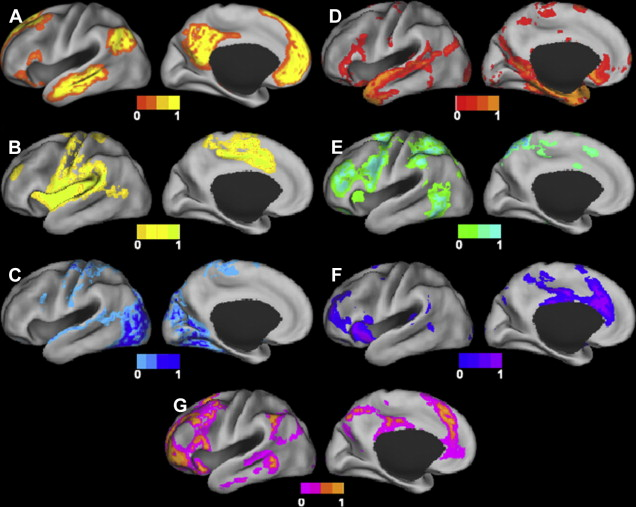
After the EEG tasks were done, and we were doing the debrief, we got to talking about the default mode network (the brain’s idle state that usually involves a lot of self-reflection), and how in DID its activity is often suppressed when doing nothing (but can be hyperactive when engaged in tasks – I think) – I thought that was really interesting.
In fact, I think it’s one of the reasons why focusing on the external world & idly self-reflecting less can be very helpful in DID (and is what many systems tend towards when they’re trying to stay well under stress – keeping busy feels like self-care) – instead allowing most self-reflection to happen while creating art, or journaling, or talking with a therapist, can be helpful – it reduces the reliance on the DMN & the disrupted brain systems that interact with it.
In DID idle self-reflection, that can be a fairly healthy part of processing, often has a tendency to become fearful in nature, rather than calm & rational – so things like holding family meetings between your parts, and giving them space to write in a journal, or to draw what they’re feeling, can really help when it comes to then reflecting in therapy.
I’ve seen the results first hand many times – that having these things in place can make a big difference when it comes to being able to remember things we’ve done, & allowing parts to express things during therapy while you stay present. It’s a really helpful thing when compared with when you’re getting lost in fearful rumination where you can’t quite put the pieces of you together because, well – that’s just not how your brain works.
Over time, internal, calm self-reflection is a skill that can be built up – but it takes practice & doing the work to get there.
—
Does understanding your own neurophysiology help?
Personally – I don’t think so, not really?
Knowing about the brain regions and what they do and how they tend to be different in DID doesn’t really help much – most of what I’ve just talked about, I know from experience – from trying things, seeing what happens, what helps, reflecting on things with a therapist we trust. The brain science is a nice extra story, as far as I’m concerned – but functionally there’s not much I can do with it.
But, and I think this is important – some people do find a certain amount of validation in knowing that you can literally see the differences in what happens in the brain activity of people with DID versus ‘normal population’ control participants or ‘DID simulators’ control participants (people who are specifically asked, for the purpose of a study, to try and act like they have DID during neuroimaging tasks).
Consistently, the DID simulators get results that look like the ‘normal control’ participants, while the DID participants brains are clearly, reliably, working in a different way.
When you consider that many people with DID are worried that they’re faking it (something that, unfortunately, some people who know nothing about the condition will also sometimes accuse people of), it can be another source of validation that… no… we’re not.
Just like ADHD, or Autism, life with dissociative identities can be thought of as a form of neurodivergence – a different way of being in the world, and just as valid as any of those, or any other way of being, for that matter.
I still think listening to people’s experiences, and believing people when they tell you what life is like for them, is where we should put our faith in the vast majority of situations – but it’s all part of developing our understanding of the science of the weird, wonderful spectrum of the human condition.
I’m proud to have been doing my bit with this study – we’ve got our last session in a couple of weeks, and it’s been a really positive experience.

Until next time – take care of yourselves, kiddos x
Riley & fam ❤


Leave a Reply