
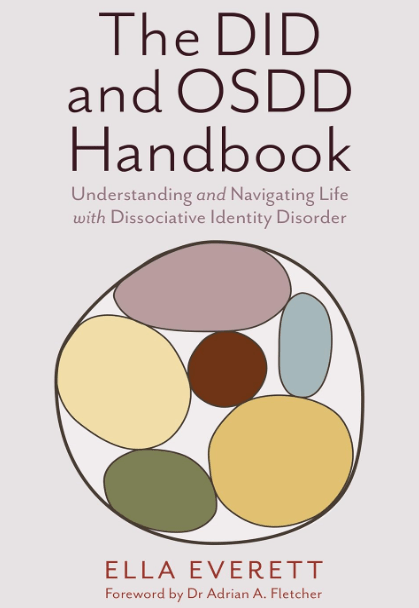
… by Ella Everett, foreword by Dr Adrian Fletcher.
==
A Brilliant Adaptation: How DID and the power of the therapeutic bond saved me, by Sally Maslansky, sounds like a great book, from what we’ve heard. Well, this post isn’t about A Brilliant Adaptation, because we read the first chapter and honestly, were finding it too intense.
We’re looking forward to going back to it when we’re ready, but it includes some very intense and prolonged descriptions of trauma & therapy (both of which can be a lot when it comes to DID!)
So, in the meantime, we picked up this book – The DID and OSDD Handbook: Understanding & Navigating Life With Dissociative Identity Disorder. Published late last year, and written by someone with lived experience of DID, it’s less of a first hand account of the emotional intensity of complex dissociation, rather, an overview of a wide variety of topics relevant to living & healing with those conditions.
It contains a lot of good stuff on what I imagine are the questions almost every DID / OSDD system has once the genie starts coming out of the bottle (so to speak). Things that I know I wish I had a good starting “handbook” for early on – every system may be unique, but I imagine most of us go through trying to figure out things like, “Am I a we?… no… are we an I? “… wait… what about the fact we’re different genders?!” (etc etc) at some point, for example!
It’s a lot of the kind of stuff that I ended up trawling through psychiatric journal articles, clinical textbooks (like The Haunted Self), and various blog posts and YouTube videos to find. Things like:
- Pronouns, both in terms of gender, and singular v plural
- System communication, including helpful journaling techniques
- System birthdays!
- Alters and system dynamics, names, interests
- ‘Coming out’ as a system…
… and much more besides.
I’d definitely say it goes wide & ‘shallow’ (in the sense that it doesn’t go into any one topic in a lot of depth), but when you have lots of questions and you can’t find anything without trawling the internet & still coming up blank half the time, I think there’s a lot of value in just knowing:
You’re not alone in having these questions… and yeah, finding what works for you might not be easy – but other people are finding their way with life as a system… & you can too
Digging through The Haunted Self trying to figure out how on earth to do something useful with all that info on action systems, APs, EPs, and the like… when what I really wanted to know was stuff like, “How do I handle the fact that everyone feels like they have different birthdays? I just want everyone to feel included!“…. it’s a very different angle to come at things!
It rarely presents, “This is the one correct answer” and instead, “Here’s what some systems do & what you could try” along with boxed-out sections on what the author personally finds works for them, and, “Tips for supporting people with DID and OSDD”, which is really lovely to see.
So if that sounds interesting to you, give it a read, and maybe consider recommending it to someone in your life who’d like to learn a little more!
It’s highlighted for us just how far we’ve come, as we’ve been reading – feeling like we’re among those finding their way through a lot of this stuff, piecing together whatever we can. It’s a nice feeling, and being given this chance to stop and reflect on that for a moment is welcome, too.
Until next time,
Take care of yourselves kiddos
Riley & fam ❤


Leave a Reply